Blog

Local small business in Rush County, Indiana

Have a Business Idea? 5 Questions to Answer Before You Launch

Thinking about starting a business in Rush County? You may have a great idea, a side hustle that’s gaining traction, or a skill you’ve wondered whether you could turn into a business. But knowing where to begin can sometimes be the hardest part.

Sometimes it starts with someone saying:

“I wonder if people would pay me to do this.”

It may be a product you’ve started selling to friends. A service people regularly ask you to provide. A skill you’ve considered turning into a side business. Or an idea you’ve been carrying around for years but haven’t known what to do with.

If you’re thinking about starting a business in Rush County, you don’t need to have everything figured out before taking the first step.

But there are some important questions worth answering before investing significant time or money.

1. What Problem Does Your Business Solve?

A good business idea isn’t simply something you enjoy doing.

Someone else has to value it enough to pay for it.

Start by identifying the customer you believe would buy your product or service and why.

What problem are you solving?

What need are you filling?

What would make someone choose your business instead of doing nothing—or buying from someone else?

Indiana’s entrepreneurship resources encourage prospective business owners to research whether their idea addresses an actual market need before investing heavily in launching it. The Indiana Small Business Development Center can also provide entrepreneurs with access to market research and confidential business advising at no cost.

You don’t need a hundred-page market study to begin.

You do need to know who your customer is.

2. Have You Talked to Potential Customers?

Friends and family saying, “That’s a great idea!” can be encouraging.

It isn’t necessarily market research.

Try talking to people who would actually be potential customers.

Ask what they currently use or buy. Find out what they like and dislike about existing options. Learn what matters most when they make a purchasing decision.

If you’re already operating informally or as a side hustle, pay attention to what your actual customers are telling you.

Which products or services sell?

What questions do customers repeatedly ask?

What do they request that you don’t currently offer?

Real customer behavior can teach you considerably more than guessing what people might want.

3. Do the Numbers Work?

Revenue and profit are not the same thing.

If you sell something for $50, that doesn’t mean you’ve made $50.

Before setting a price, identify the costs associated with delivering your product or service. Depending on the business, those might include materials, supplies, shipping, payment-processing fees, insurance, equipment, transportation, advertising, professional services and your own time.

Then ask a critical question:

Can I charge a price customers will pay and still operate profitably?

Understanding your numbers before you grow can prevent a common small-business problem: creating plenty of work without creating enough income.

This is also why financial planning and recordkeeping matter even when a business is very small.

4. What Needs to Happen Before You Make It Official?

One of the most confusing parts of entrepreneurship can be figuring out what paperwork actually applies to your business.

Indiana’s INBiz portal is the state’s one-stop resource for registering and managing businesses. It provides information about business structures, name availability, registered agents and state filing requirements.

Depending on the type of business, additional tax, licensing, employer or local requirements may also apply. The Indiana Department of Revenue notes that new businesses may need to register for appropriate state tax accounts through INBiz.

That doesn’t mean your first step should automatically be filing an LLC.

Your first step should be understanding which steps apply to your particular business.

Getting good information before filing paperwork can save time, money and frustration later.

5. What’s Your Next Step—not Your Next 50 Steps?

Starting a business can feel overwhelming because entrepreneurs often try to solve every future problem at once.

What should the business be called?

Do I need an LLC?

What about taxes?

Do I need a website?

How do I market it?

Where will I get financing?

Should I open a business bank account?

What records should I keep?

Those are legitimate questions.

They just don’t all have to be answered today.

Instead, identify the next useful step.

Maybe that’s talking with five potential customers.

Maybe it’s calculating the true cost of your product.

Maybe it’s meeting with a business advisor.

Maybe it’s learning what a lender would want to see.

Or maybe you’re ready to formalize a business you’ve already started.

Progress becomes much more manageable when you stop trying to build the entire business at once.

Rush County Entrepreneurs Don’t Have to Figure It Out Alone

If you’re considering starting a business in Rush County, you don’t have to figure everything out on your own.

Rush County ECDC and our regional partners are currently offering another resource specifically for people at this stage.

The Regional Entrepreneurial Pipeline (REaP) is a free workshop series serving new and early-stage entrepreneurs in Rush, Fayette and Henry counties.

REaP is designed for people with a business idea, side hustle, home-based business or young business they want to strengthen. Topics include business readiness, banking and lender expectations, customers, pricing, sales, marketing, business formation, recordkeeping and other practical steps involved in building a business.

Participants can choose the sessions that fit their needs and participate either in person or virtually.

You don’t need to arrive with everything figured out.

That’s the point.

Have an idea you’ve been thinking about?

Visit the Regional Entrepreneurial Pipeline (REaP) page to learn more and register.

Sometimes the difference between an idea that stays an idea and one that becomes a business is simply knowing what to do next.
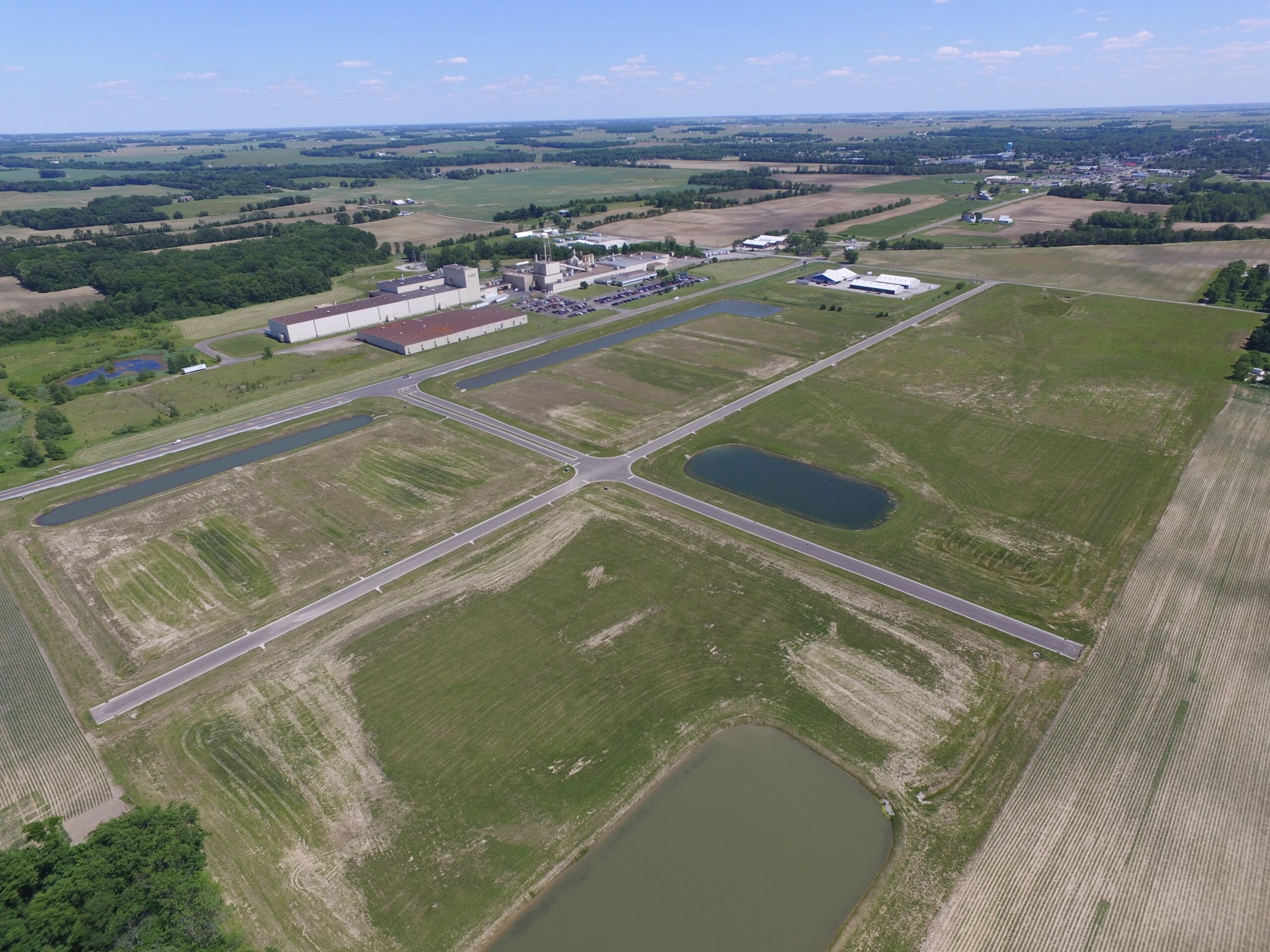
Rush County development-ready sites at Commerce Park at Rushville

Why Development-Ready Sites Matter to Rush County’s Economic Future

Economic development often becomes visible when a company announces an expansion, construction begins or new jobs are created.

But much of the work that makes those opportunities possible happens years before an announcement.

One important part of that preparation is having Rush County development-ready sites that businesses can seriously evaluate when they are considering where to locate or expand.

Companies Need Answers Before They Invest

Businesses considering a new location evaluate much more than the price of a piece of land.

They need to understand whether a site can accommodate their operation, how utilities can serve it, whether the property is appropriately zoned, how transportation connects to the site and what may be required before construction can begin.

And increasingly, companies need those answers quickly.

Indiana’s economic-development strategy emphasizes site readiness because reducing uncertainty can help companies move more efficiently through the location process. The Indiana Economic Development Corporation describes development-ready sites as an important tool for helping businesses move faster toward operational launch.

For communities competing for investment, preparation matters.

Rush County Development-Ready Sites Support Investment

One of Rush County’s major economic-development assets is Commerce Park @ Rushville, located at State Road 3 and County Road 200 North.

The Commerce Park received Indiana Site Certified Prime designation in 2019, the highest level under the state’s Site Certified program at the time. The designation followed years of local, state and federal investment in preparing the property for industrial development.

Today, ECDC’s available-sites information identifies infrastructure serving the Commerce Park that includes water, sewer, natural gas and fiber connectivity.

Those aren’t particularly flashy economic-development accomplishments.

They are, however, exactly the kinds of fundamentals that matter when a company begins evaluating whether a community can accommodate a project.

Site Readiness Reduces Uncertainty

Imagine two communities being considered for the same investment.

One has property available but still needs to determine whether appropriate infrastructure can reach it.

The other can provide information about an established development site, existing infrastructure and previous site-readiness work.

The second community can begin answering questions much earlier in the conversation.

That doesn’t guarantee that it will win the project. Businesses weigh many factors when making location decisions, including workforce, transportation, utilities, costs, incentives and proximity to customers and suppliers.

But having prepared sites means Rush County can enter those conversations with an important piece already in place.

Economic Development Requires Long-Term Thinking

The Commerce Park is also a good example of something that can be easy to overlook about economic development:

Preparation and results don’t always happen in the same year.

Infrastructure investments may be made years before a company needs them.

Workforce initiatives begin before an employer has an opening.

Housing and quality-of-place investments help create conditions that make a community more attractive to people and businesses over time.

And development sites have to be prepared before a site selector calls.

That requires communities to think beyond the next announcement and invest in the capacity needed for future opportunities.

Rush County Development-Ready Sites Are Part of a Bigger Strategy

Rush County development-ready sites are an important part of preparing our community for future business investment, even though much of that preparation happens long before a company announcement or groundbreaking. Commerce Park @ Rushville is an important asset, but it isn’t the only location ECDC can help businesses evaluate.

Companies have different requirements. Some need large acreage. Others need an existing building, commercial property, a smaller industrial site or room for a future expansion.

That’s why Rush County ECDC now offers businesses a customized property search based on project requirements such as acreage, building size, utility needs, transportation access and expansion plans.

The goal isn’t simply to have property available.

The goal is to help businesses determine whether Rush County is the right place for their investment.

That work starts long before a groundbreaking.

It starts with being ready when opportunity calls.

Considering a location or expansion in Rush County?
Visit ECDC’s Available Sites page or contact Rush County Economic & Community Development Corporation to begin a confidential property search.

Rush County talent pipeline students exploring local careers

The Talent Pipeline Starts Before Graduation: How Career Exposure Strengthens Rush County

Building the Rush County talent pipeline requires us to think beyond today’s job openings and look at the young people who will become tomorrow’s workforce. When employers talk about workforce challenges, the conversation often focuses on the people available to hire today.

But building the Rush County talent pipeline means looking further ahead. Our future workforce is already sitting in classrooms.

That is why career exploration, employer engagement and work-based learning are important parts of economic development. Helping young people understand the opportunities available close to home gives students more information when making decisions about education and careers—and gives local employers an opportunity to begin building their future talent pipeline.

Career Awareness Matters Earlier Than We Think

Students make important choices long before they submit their first full-time job application.

They choose classes. They consider college, technical education, apprenticeships and military service. They decide whether they believe they need to leave their hometown to find opportunity.

Those decisions are influenced by what students know.

A young person can live near a business for years without knowing what happens inside the building, what occupations exist there, what education those jobs require or what a career path with that employer might look like.

Creating direct connections between students and employers helps close that information gap.

Building the Rush County Talent Pipeline

Career-connected learning isn’t a new idea in Rush County.

Rush County Schools received national attention earlier this year when Business View Magazine highlighted the district’s approach to education and community partnerships. The February 2026 feature described several ways students are connecting education with career preparation, including healthcare credential opportunities and on-the-job experience through the district’s Interdisciplinary Cooperative Education program.

Those experiences matter because career exploration becomes much more meaningful when students can connect what they learn in school with an actual occupation.

The same principle is behind initiatives such as Rush County Manufacturing Day.

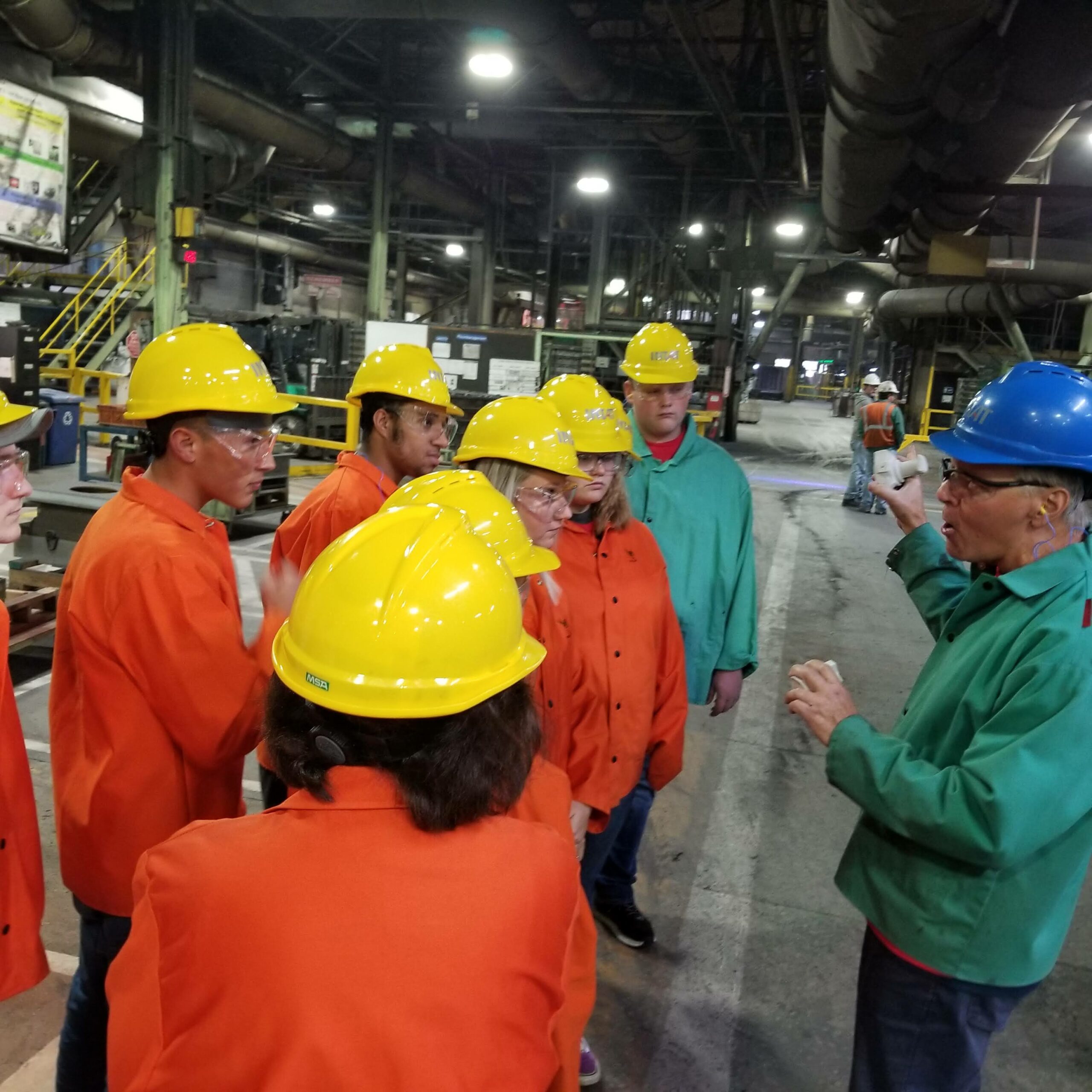
Manufacturing Day gives students an opportunity to step inside local workplaces, meet employees and learn about career pathways they may otherwise never see. Rush County ECDC is again working with local education and employer partners on Manufacturing Day activities in 2026.

Employers Have a Role in Building Their Future Workforce

Employers don’t have to wait until students graduate to participate in workforce development.

There are many ways businesses can help young people better understand the world of work.

Hosting a tour can introduce students to occupations they didn’t know existed.

Speaking to a classroom can help explain which skills employers value.

Providing job-shadowing or work-based learning opportunities can give a student firsthand experience.

Participating in career events can help students connect a company name they recognize with actual careers and the people who perform them.

Even a conversation with an employee can change how a student thinks about a career.

These interactions aren’t necessarily about recruiting a teenager for an immediate opening.

They are about building awareness.

Career Exposure Also Helps Students Make Better Decisions

A strong talent pipeline benefits employers, but students benefit too.

The more students understand about occupations, workplace expectations, education requirements and career pathways, the better equipped they are to make decisions about what comes after high school.

For one student, that may mean a four-year degree.

For another, it may mean technical training, an industry credential, an apprenticeship or entering the workforce.

There isn’t one correct pathway.

The goal is to make sure students know the pathways exist.

Showing Young People They Can Build a Future Here

Talent attraction will always be important to economic development, but communities also have an opportunity to develop and retain the talent already growing up within them.

That starts with visibility.

Young people need opportunities to see local workplaces, meet people building successful careers and understand how education connects to employment.

Employers need opportunities to communicate the skills and qualities they will need from tomorrow’s workforce.

Schools need partners who can help make classroom learning relevant to life after graduation.

When those pieces come together, career exploration becomes more than an educational activity.

It becomes economic development.

Rush County ECDC will continue working with employers, educators and workforce partners to help create those connections and strengthen the pipeline between education and opportunity in Rush County.

Why a Busy Downtown Matters to Rush County’s Economy

A strong downtown Rushville economy is an important part of economic development in Rush County.

Economic development doesn’t happen only in industrial parks. It also happens when someone opens a small business, a family spends Saturday morning downtown, a visitor discovers a local restaurant or shop, and community events bring people together in places Rush County has invested in creating.

It also happens when someone opens a small business, a family spends Saturday morning downtown, a visitor discovers a local restaurant or shop, and community events bring people together in the places Rush County has invested in creating.

Rushville will have a good example of that in action on Saturday, September 19, when Willkie Days—also promoted as Rush Fest—returns to downtown Rushville.

The Rush County Chamber of Commerce-organized event is scheduled from 9 a.m. to 2 p.m. and will bring local shops, vendors, food, children’s activities and community members together downtown.

But events like this have value beyond a single Saturday.

The Downtown Rushville Economy Supports Local Business

Small businesses are an important part of the downtown Rushville economy and the broader Rush County economy.

Community events can introduce residents and visitors to businesses they haven’t tried before, create opportunities for entrepreneurs and vendors to reach customers, and generate additional foot traffic for established downtown businesses.

Willkie Days is particularly well positioned for that this year because it overlaps with the Heart of Rushville Farmer’s & Artisans Market, which is scheduled from 9 a.m. to 12:30 p.m. September 19. The market provides a regular downtown outlet for local produce, baked goods and handcrafted products.

For someone testing a product, building a customer base or operating a very small business, markets and community events can provide valuable exposure.

For existing storefronts, they bring potential customers directly to the neighborhood.

Quality of Place Is Part of Economic Development

There is another reason vibrant community spaces matter to Rush County ECDC.

Businesses don’t make location and expansion decisions based on buildings and infrastructure alone. Workers and their families also make decisions about where they want to live.

That makes quality of place part of the economic-development equation.

A downtown that offers local businesses, public events, entertainment and opportunities for people to gather contributes to the experience of living in a community.

On September 19, Rushville will have several examples happening on the same day.

In addition to Willkie Days and the Farmer’s & Artisans Market, the Rush County Community Calendar currently lists the Summer Concert Series season event at Riverside Park Amphitheater that evening, with On the Border – The Ultimate Eagles Tribute and The Morgan After Band.

The Princess Theatre also has performances scheduled that weekend.

Together, activities like these give residents reasons to spend time locally and give visitors reasons to experience Rushville.

Entrepreneurship Often Starts Small

Downtown events also connect directly to another ECDC priority: entrepreneurship.

Not every business begins with a building, employees and a large investment.

A business may begin at a kitchen table, in a garage, online or with someone selling a product at a local market.

Creating places where small and emerging businesses can meet customers helps build an environment where entrepreneurship is visible and accessible.

Rush County ECDC is working on that same goal through the Regional Entrepreneurial Pipeline, or REaP, which provides free workshops and resources for new and early-stage entrepreneurs in Rush, Fayette and Henry counties.

Community events and formal entrepreneurship programs serve different purposes, but they reinforce the same idea:

Local businesses need opportunities to start, connect with customers and grow.

Supporting the Downtown Rushville Economy

Willkie Days is a celebration, not an economic-development program.

And that is precisely the point.

Economic development ultimately isn’t just about completing projects. It is about building a community where businesses can succeed and people want to spend their time, build careers, raise families and invest.

Sometimes supporting that goal is as simple as showing up.

Visit downtown. Explore a business you haven’t visited before. Meet a local vendor. Have lunch. Attend an event.

Every local purchase won’t transform an economy by itself.

But strong local businesses, active community spaces and residents who support them are all pieces of a stronger Rush County.

Willkie Days / Rush Fest
Saturday, September 19, 2026
9 a.m.–2 p.m.
Downtown Rushville

For the most current event information, visit the Rush County Community Calendar.

Rush County students touring a local manufacturing facility during Manufacturing Day

Why Manufacturing Day Matters for Rush County’s Future Workforce

Manufacturing Day is coming this October, and Rush County Economic & Community Development Corporation is once again working with local education and employer partners to help students explore careers available close to home.

National Manufacturing Day will be observed on Friday, October 2, 2026. Organized by the Manufacturing Institute, the annual initiative encourages manufacturers and their partners across the country to introduce students, educators and communities to modern manufacturing through plant tours, hands-on experiences, career conversations and other activities.

For Rush County, Manufacturing Day is about more than celebrating an industry.

It is about building a stronger local talent pipeline.

Read More

Regional Entrepreneurial Pipeline Launches to Support Small Business Growth in Rush, Fayette, and Henry Counties

Rush County ECDC, in partnership with Fayette County and Henry County economic development collaborators, is preparing to launch the Regional Entrepreneurial Pipeline, also known as REaP.

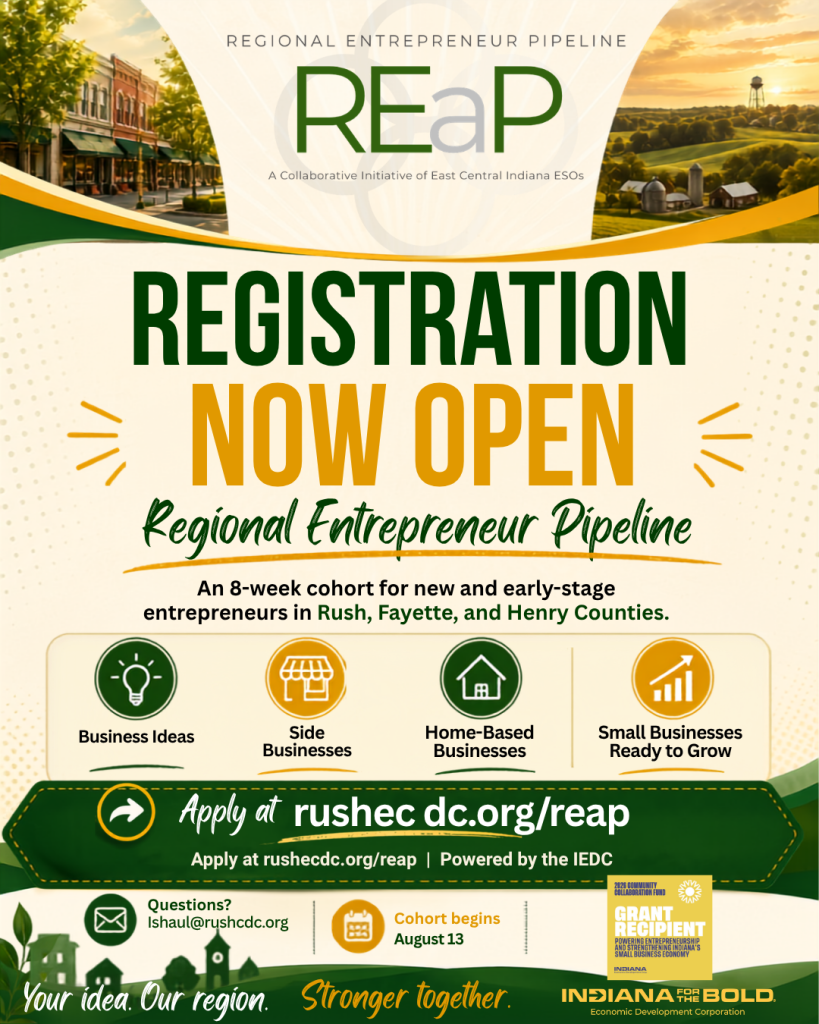
REaP is an 8-week cohort program designed to help new and early-stage entrepreneurs in Rush, Fayette, and Henry Counties take practical next steps toward starting, formalizing, or growing a business.

Participants will learn about business readiness, banking and lender expectations, customers, pricing, sales, marketing, social media, LLC registration, EIN setup, INBiz registration, business banking, recordkeeping, and local small business resources.

The first cohort began October 1st, 2026!

Apply for REaP here:
https://www.rushecdc.org/reap/

Learn more about the Governor/I​EDC Community Collaboration Fund announcement here:
https://events.in.gov/event/gov-braun-strengthens-indiana-entrepreneurship-through-community-grants

Community Collaboration Fund Supports Regional Entrepreneurial Pipeline

Regional Partners Launch Regional Entrepreneurial Pipeline to Support Small Business Growth

Rushville, Ind. – Rush County Economic & Community Development Corporation, in partnership with Fayette County and Henry County economic development collaborators, is preparing to launch the Regional Entrepreneurial Pipeline (REaP), a regional initiative designed to support new and early-stage entrepreneurs across East Central Indiana.

The program is supported through Indiana’s Community Collaboration Fund, administered by the Indiana Economic Development Corporation. The Regional Entrepreneurial Pipeline will provide practical, hands-on support for individuals who have a business idea, operate a side business, recently started a business, or are ready to take the next step toward formal business ownership.

To learn more about the Governor and IEDC announcement and all Community Collaboration Fund grantees, visit: https://events.in.gov/event/gov-braun-strengthens-indiana-entrepreneurship-through-community-grants

The first cohort is scheduled to begin soon and will serve participants from Rush, Fayette, and Henry Counties. Weekly sessions will focus on business readiness, banking preparation, marketing, customer identification, pricing, business formation, and local small business resources.

“The Regional Entrepreneurial Pipeline is about meeting entrepreneurs where they are and helping them take practical next steps,” said Leslie Shaul, Workforce Manager for Rush County Economic & Community Development Corporation. “Many people have strong business ideas but are not sure how to move forward. This program is designed to connect them with the information, partners, and support they need to build a stronger foundation.”

The cohort will include sessions led by regional partners, Ivy Tech, local banking professionals, small business resource providers, and subject matter experts. Planned session topics include entrepreneur readiness, banking readiness, marketing, social media, pricing, business formation, LLC registration, EIN setup, INBiz registration, and next-step resources.

A key component of the program will be the Business Formation Lab, which is designed to help eligible participants understand the process of formally organizing their business. Eligible participants may receive assistance with approved LLC registration costs through the program.

The Regional Entrepreneurial Pipeline is intended to strengthen the region’s small business ecosystem by helping entrepreneurs better understand the steps involved in launching, organizing, and growing a sustainable business. The program also aims to build stronger connections between entrepreneurs and local support organizations, banks, chambers, technical assistance providers, and economic development partners.

“This is a regional effort,” Shaul said. “Rush, Fayette, and Henry Counties all benefit when local entrepreneurs have better access to practical support, trusted resources, and clear next steps. Our goal is to make the process less overwhelming and more accessible.”

Registration is available online at https://www.rushecdc.org/reap/. Space may be limited, and early registration is encouraged. Questions may be directed to Leslie Shaul at lshaul@rushecdc.org.

###

About Rush County Economic & Community Development Corporation

Rush County Economic & Community Development Corporation works to support business growth, workforce development, community investment, and quality-of-life initiatives throughout Rush County.

About the Regional Entrepreneurial Pipeline

The Regional Entrepreneurial Pipeline is a regional entrepreneur support initiative serving Rush, Fayette, and Henry Counties. The program is designed to help new and early-stage entrepreneurs gain practical knowledge, connect with local resources, and take meaningful steps toward business formation and growth.

About the Community Collaboration Fund

The Community Collaboration Fund (CCF) is a program of the Indiana Economic Development Corporation (IEDC) designed to inspire new, community-led collaborations and programming that drive entrepreneurial education, tech enablement and small business acceleration statewide. CCF grants enable Entrepreneur Support Organizations (ESOs) to implement initiatives that serve Indiana’s entrepreneurs and small businesses and fill critical ecosystem gaps across Indiana’s regions.

Regional Entrepreneurial Pipeline | Rush, Fayette, and Henry Counties