Rushville utilizes Brownfield Grant for redevelopment, building cleanup
In 2015, the City of Rushville applied for and received a Brownfield Assessment Grant from the Environmental Protection Agency’s (EPA) Region 5 office in Chicago.
According to the EPA, these grants provide funding for brownfield inventories, planning, environmental assessments and community outreach.
“These are monies we put out on a competitive basis to primarily local governments,” Brownfields Coordinator with the EPA’s Region 5 office Matt Didier said. “They take that money and do the necessary environmental investigation at properties, which these grantees believe are good candidates for economic redevelopment, but concerns about possible environmental contamination are holding these projects back.”
The EPA gives out $60 million in Brownfield Grants annually. Didier said all investments must have big payoffs for the grantee community.
Approximately only one-third of all applicants receive a three-year Brownfield Grant.
“Just to get the grant Rushville had to do some good work,” Didier said. “They got some help from the Rush County Economic and Community Development Corporation (ECDC) in not only applying for the grant but also for its management.”
City officials used the grant for work and assessment at 10 sites in Rushville including the Durbin Campaign Quarters, Campaign Flats, Knights of Pythias Hall and other locations. The EPA’s investment into the Durbin Campaign Quarters was $61,205 and another $26,000 went toward the work force development training center in downtown Rushville.
“They’re going to go into the building to identify old hazardous materials that would have been in the building from previous uses,” Didier said. “So lead based paint, which was used in every building built before 1972. There’s often asbestos in these buildings because asbestos was used in things you wouldn’t even think about. Some of them may have had old heating oil tanks or there may have been a service station associated with them. These are the kind of concerns when a new purchaser is looking at a building, before they start, they want these kind of questions answered.”
Didier said Brownfield Grants help answer some of those lingering questions.
Once a city is awarded a grant, the EPA steps back and lets the grantee determine how and where to utilize the funds. However, the EPA does make sure the money is managed efficiently within the grant program’s regulations.
“They’ve been flexible and we’ve been thoughtful in the projects we’ve done,” Director of the Rush County ECDC John McCane said. “In a perfect world we use their funding to find out that everything’s fine. This takes away a lot of that mystery and there’s security of the property owner before you buy knowing you’ve covered your bases.”
Didier, McCane, and other EPA representatives recently toured local projects where Brownfield Grant funds were used. Didier said he appreciated the work the city has done.
“My opinion of what they’ve done here is great. We always like to see it when you can use our money to rehab buildings,” Didier said. “That’s one of the uses of our money that has the biggest payoff. When you’re rehabbing a building you’re bringing in a lot of money for the rehab work and then you’re going to have continued revenue and tax stream from whatever’s going into that building. We always love to see these kinds of projects.”
In addition to Indiana, the EPA’s Region 5 office oversees grant programs in Wisconsin, Minnesota, Michigan, Ohio and Illinois.
“Compared to where a lot of our grants go, Rushville is a small community. You wouldn’t immediately think a town of 6,200 has a lot of environmental problems that need to be dealt with before you can take on economic redevelopment,” Didier said. “Rushville has proved that really is not the case. For the amount of money Rushville has been able to obtain through the grant they’ve done just as much as any other grantee I’ve ever worked with. The ECDC had a really important part in the management and success of this grant program.”
—
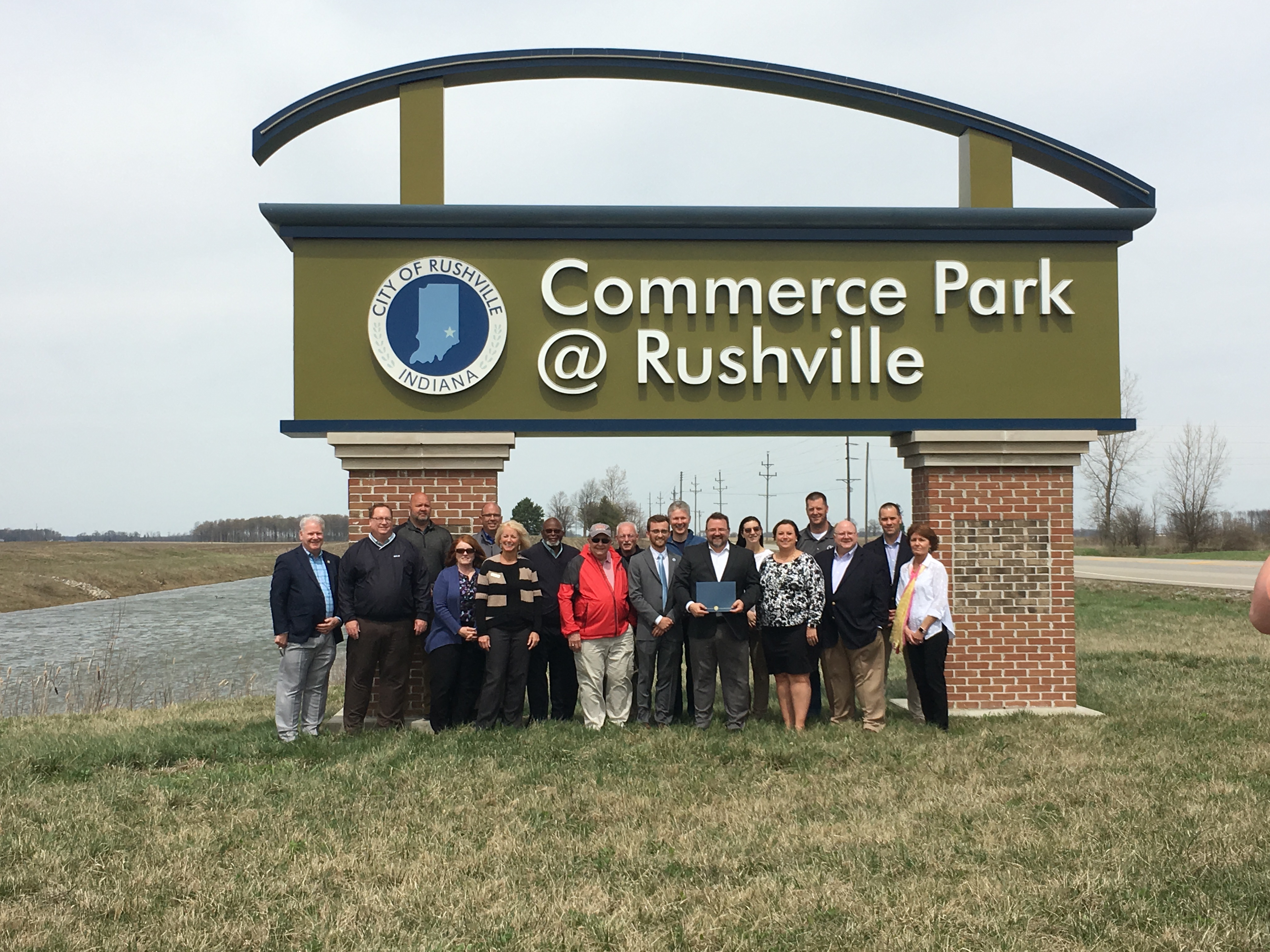
Commerce Park receives Indiana Site Certified Prime Designation
Officials from the Indiana Office of Community and Rural Affairs (OCRA), the Rushville Redevelopment Commission and the City of Rushville announced the Commerce Park at Rushville was designated Indiana Site Certified Prime.
“We are honored to receive the ‘Prime Shovel Ready Certification’ from the State of Indiana,” Mayor Mike Pavey said. “The Commerce Park at Rushville is recognized at the highest level established for industrial development sites in the state.”
The 288 acre site is key in demonstrating the industrial park’s logistical advantages, and is owned and optioned by the Rushville Redevelopment Commission and is zoned for heavy manufacturing.
“The availability of project-ready sites is critical to attracting new investment to rural Indiana and spurring economic growth,” Executive Director of OCRA Jodi Golden said. “Today’s economic development projects move at a swift pace and require sites be developed quickly. I want to congratulate the leadership and local partners of the Commerce Park at Rushville on receiving the prime designation.”
The city has invested millions of dollars in recent years with an initial acreage purchase under former Mayor Bob Bridges. In 2012, the city was awarded a $1.77 million grant from United States Economic Development Administration. Under Mayor Pavey’s leadership, the grant was matched with $1.77 million in local funds to develop the park to be shovel and backhoe ready.
“With less than 10 Prime Certified sites in the state, this provides an immediate advantage to our community,” Executive Director of the Rush County Economic and Development Corporation John McCane said. “The prime designation sets us apart from most communities around the state, and it will show site consultants and industries looking to expand that Rushville has one of the best sites for immediate development.”
The Indiana Site Certified Program validates sites that are ready for economic development. The program is administered by OCRA in partnership with the states Fast Access Site Team, which is comprised of multiple state agencies.
These agencies include the Indiana Department of Transportation, Indiana Department of Environmental Management, Indiana Department of Natural Resources and the Indiana Economic Development Corporation.
The Indiana Site Certified Program divides industrial sites into Silver, Gold and Prime designations. The Commerce Park received Prime designation, which is the program’s top tier.
Receiving an Indiana Site Certified Prime designation means a site has/is:
- 30 contiguous acres
- At least 2.5 miles from a State Highway
- Properly zoned
- Geo tech studied
- No recs or site clear
- An archaeological investigation
- The utility to property line or future build located in public right of way
- LUG, LEDO or REDO must own property or have agreement with property owner
Site Selection Magazine Recognizes “Stellar” Rush County
Shining Stars
A program focused on quality of place is yielding positive economic and wellness results in 16 small Indiana towns — with more to come.

If you’ve seen the inspirational film “Breaking Away,” you know that the locals known as “cutters” got their name from Indiana’s limestone business, which has produced stone for famous structures around the world.
You can find out all about it at the Land of Limestone Museum, housed within Stonegate Arts & Education Center (a former Indiana Limestone Co. facility) in Bedford, a town of 14,000 known as the “Limestone Capital of the World.” Among other functions, StoneGate provides space to Ivy Tech Community College and Oakland City University.
The project is one of 12 pursued thanks to $19 million in funding from the city’s 2013 designation as an Indiana Stellar Community — one of 16 areas so designated since the program’s inception in 2011.
“Of all the projects, that’s the one I’m most passionate about,” says Bedford Mayor Shawna Girgis.
Bedford projects ranged from downtown streetscaping to the movement of an historic depot to a downtown spot where it serves as a tourism center and the trailhead for a blossoming network of rails-to-trails. “That was the most out of the box,” Girgis says, because it addressed property and redevelopment as well as community health.
Catalyst for Transformation
Indiana Stellar Communities, administered by the Indiana Office of Community and Rural Affairs (OCRA), works with communities to develop their strategic community investment plans, promote local and regional partnerships and implement comprehensive solutions to challenges facing Indiana’s rural communities. In a nutshell, with assistance from Ball State University’s Indiana Communities Institute and Purdue University’s Center for Regional Development, the program helps nudge plans into reality.
“It’s transformed the area,” says Girgis.
Bedford is in a county partly served by Hoosier Energy, a generation and transmission cooperative serving 18 member electric cooperatives in central and southern Indiana and southeastern Illinois.
“Their economic development arm has been a huge asset to our community,” Girgis says of working with Hoosier Energy’s team over the years. “They’ve been great partners.”
‘The Opportunity to Be Themselves’
Other Stellar communities include North Vernon. Led by Kathy Ertel, Jennings County Economic Development executive director, the city was the first Stellar designee in 2011. As a result of Stellar projects, Ertel says she’s noticed increased investment from property owners in their downtown businesses and residences.
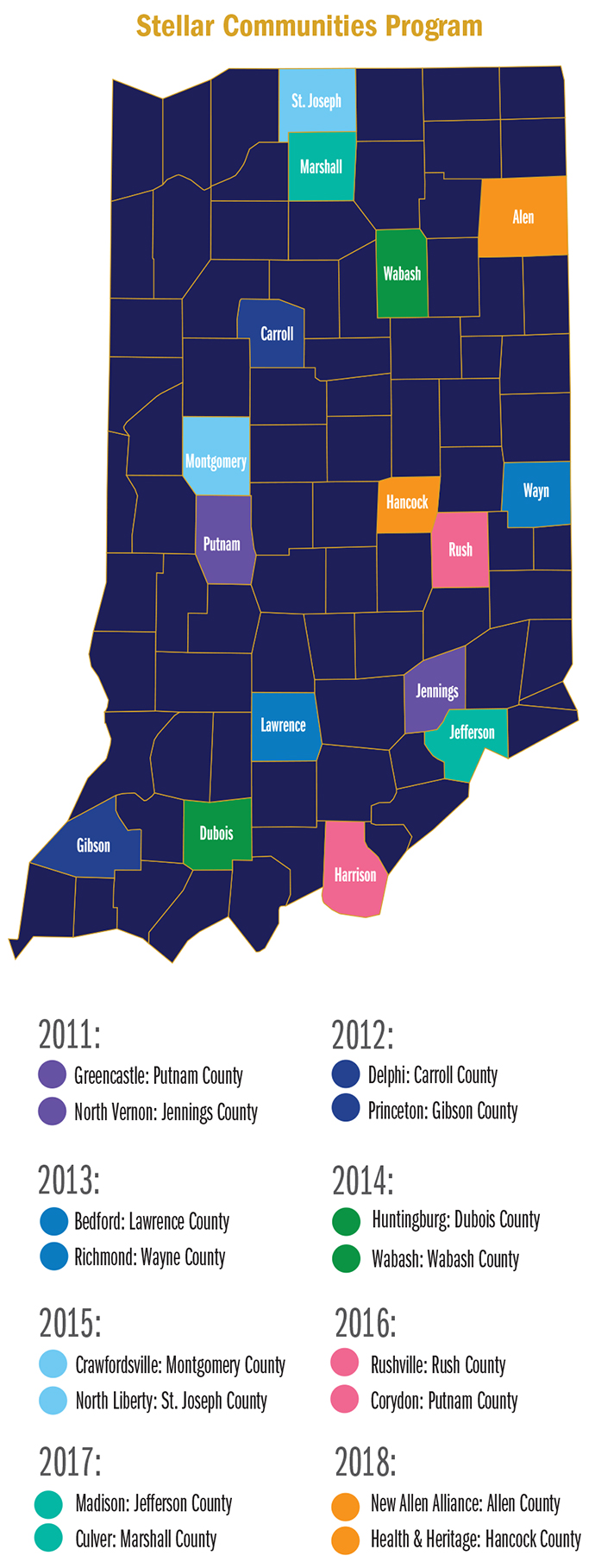
“Since becoming a Stellar Community, Richmond has benefited in many ways,” says Valerie Shaffer, president of the Economic Development Corporation of Wayne County. “The most visible project has been our new pocket park, Elstro Plaza, that converted an under-utilized parking lot into a central gathering place downtown that hosts a variety of events and festivals,” including a weekly farmer’s market that’s grown 10-fold since coming to the new spot.
“Elstro Plaza also allows the growing number of workers, merchants and area residents a green space to enjoy regularly,” she says. “New specialty shops on the ground floor with upstairs living for the owners is a new trend thanks to our owner-occupied housing program. All of this has helped to attract Reid Health’s back-office operation downtown, bringing over 100 workers to the area to take advantage of our new amenities.”
OCRA Deputy Director Matt Crouch says Stellar is about “breaking down siloes in coming up with a community plan, and in so doing, having the opportunity to accomplish in five years what might otherwise take 15. He says the mayor of Huntingburg has told him simply getting the designation has led to firms choosing to locate there that never would have looked outside the county seat of Jasper before. Delphi, a bedroom community to Lafayette-West Lafayette, is restoring a historic theater. Princeton — home of a major Toyota plant — is improving its quality of life so fewer Toyota employees are commuting long distances.
“I think the designation in some of these smaller communities has provided them with the opportunity to be themselves,” says Michael Sinnet, OCRA project manager handling the Stellar Communities program. In other words, a blockbuster project might take the form of block-by-block rejuvenation. “Maybe it’s just populating their downtown with entrepreneurs and small businesses,” he says, “things that increase the quality of place.”
“Since Rushville was named an Indiana Stellar Community in 2016, we have seen a true rebirth of our downtown,” says John McCane, executive director, Rush County Economic & Community Development Corporation. “We are currently tracking 86 public and private projects that constitute $91 million of investment from 2018 to 2020. Rushville is leading the way in rural Indiana, and Stellar has been the catalyst.”
Rushville Community Celebrates Grand Opening of Rush to Work Job Center
Rush to Work Job Center offers a unique “one-stop-shop” benefiting employers and job applicants alike.
Partnership was the catalyst and cause for celebration Wednesday, February 7, as the Rushville, Indiana community cut the grand opening ribbon for the Rush to Work Job Center. Born of a collaboration among Eastern Indiana Works, Ivy Tech, the City of Rushville, and Rush County Economic & Community Development Corporation, the newly unveiled job center promises a unique regional training concept to bring employers and job seekers together.
“The Rush to Work Job Center is a testament to what a community can accomplish when all the players affected by a particular issue come together to find the right solution,” said Rushville Mayor Mike Pavey. “We know that Rushville has a population of unskilled workers. Ivy Tech wants to train those workers and EIW wants to put those folks to work. Then our local industries and businesses need those employees. This building is the ‘one-stop-shop’ where that is going to happen.”
The 6600 square-foot building, located at 306 N. Main in Rushville, a once dilapidated structure, has been completely remodeled. It is now divided to allow space for the local WorkOne office on the west end and the multi-use training space on the east. WorkOne is open Monday – Friday from 8 a.m. – 4:30 p.m., where career advisors assist potential employees with job applications, resume and interview coaching, and information about education and training options. The area includes a conference area, classroom, and computer stations.
“We try to align our partnerships to the highest level,” said Mike Row, the CEO of EIW. “This Job Center is very important to the future of our region.”
Kim Thurlow, Ivy Tech Workforce Consultant and Dean of Advanced Manufacturing, Engineering and Applied Science, guided the design of the training area drawing from her 20+ years with the school. There are two classrooms, one for a computer room and the other with desks designed for lecture-style learning. Each room has a window looking out into the open training area, so those utilizing the classrooms can see the functionality of the adjacent space. The open concept room affords trainers to set up the room to suit their needs. Additionally, a space enclosed by two overhead doors allows large equipment to be unloaded and stored out of sight until needed.
Thurlow said, “I’ve worked many years seeing other communities come together but Rushville has a certain chemistry. They have the commitment and the employers who have embraced this Center to say what they need for current and future employees. This community has truly come together to assist their employers and their residents in skilling up.”
Classroom furniture was generously provided by Ivy Tech. Other furnishings, technology, and equipment purchases will be paid for with funding from the USDA Rural Development grant program. What will be bought will be mostly guided by a steering committee headed by the Rush County ECDC office. The steering committee is led by representatives of all Rush County industries.
“Today is giant step forward for Rushville, especially for the ECDC’s workforce development plan. We want every regional industry and business to know that the Rush to Work Job Center is open ready for their use,” said John McCane, Rush County ECDC Executive Director. “Economic development is not just a local issue; our region, our state, will rise when we work together. The Job Center was only accomplished through partnerships and we want its success to evolve in that spirit.”
To book the Rush to Work Job Center training space, call the Rush County ECDC office at (765) 938-3232. To reach the Rushville WorkOne office, phone (765) 932-5921.
Economic development leaders discuss jobs and training center
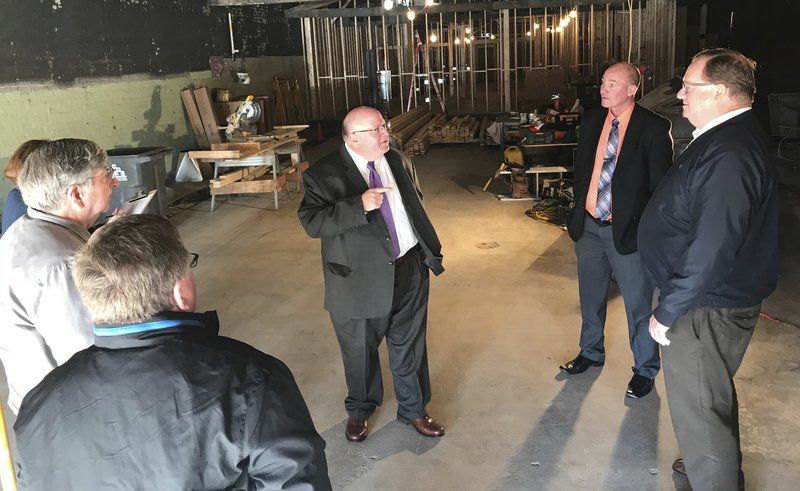 Economic development stakeholders inspected the redevelopment efforts of the former “Bowen-Carter” building in downtown Rushville this week. When completed, the front of the building will house the local WorkOne office managed by Eastern Indiana Works. The rear of the building will be the home of a new manufacturer-driven regional training center under the direction of the Rush County ECDC. Ivy Tech has been working to partner with the ECDC to deliver training opportunities. When completed, the community is going to have a one-stop shop that allows unemployed and under-employed workers to go to a single location to improve their skill sets and to seek new employment. The project is expected to be completed in the fall of 2018.
According to economic development officials, there is a great need to train more people to fill the jobs pipeline with extremely low unemployment rates. According to the most recent figures released by the State of Indiana, Rush County ranks 72nd out of Indiana’s 92 counties in regards to low unemployment. Rush County leads their economic growth region for employment with an unemployment rate of 3.2%.
“All of our local manufacturers are hiring,” ECDC Director John McCane said. “It is our goal to create a one-stop shop where someone unemployed can not only sign up for a job, but they can also get the testing and training that will help them get a new or better job. This is a critical component in the ECDC’s workforce development plan.”
According to local officials, the new training center is owned by the ECDC, which is a public-private not-for-profit. Through this partnership, funding comes from the City of Rushville, Rush County, the Town of Glenwood and partner memberships. The building will be funded through lease revenues, investment from industry partners, grants and with ECDC funds on hand.
“We have had people ask if the Bowen-Carter name will continue to grace the downtown,” Mayor Pavey said. “As a community, we have highly invested in our local historic fabric. However, the new façade will be of such significance that the look will need to change. The original lettering is off-center and does not lend itself for symmetry or aesthetic sense.”
The Mayor did say that efforts are underway to find a way to recognize the history of the Bowen-Carter building. Pavey stated that the ECDC and the city intends to recognize the historical significance of the building perhaps through sidewalk bricks, or photo displays in the lobby, or both.
Eastern Indiana Works plans to move into the rehabilitated building immediately upon completion. Research into the topic indicates a Workforce Training Center with workforce development training programs that are manufacturer-driven is necessary to keep our community and region relevant in the workforce arena. Surveys and conversations with local and regional employers indicate buy-in at all levels.
The ECDC has partnered with the Rushville Street Department in the rehabilitation of the jobs training center. The street department staff has been working on demolition efforts and concrete work. Through this cooperation, those items completed locally come off the bottom line of the contract and provides projects to the department during slower times and off-season.
“I can’t say enough for the hard working staff of the Rushville Street Department,” ECDC Chairman David Reid said. “Through their expertise and talents, we have been able to save considerably on this project. There is no doubt that they have helped us move this project along faster and with fiscal responsibility.”
Local officials believe that the new workforce center will complement the State of Indiana’s direction as the State Legislature and the Governor’s Office join efforts to grow job skill sets throughout the state. The Indiana Department of Workforce Development estimates there will be more than one million jobs to fill in the state by 2024 – and most of them won’t require a college degree. Instead, many employers will be looking for highly-skilled workers with specialized certificates to fill positions in everything from manufacturing to healthcare.
“We have to have this ready, skilled-up workforce here at home, right in our backyard,” Indiana Governor Eric Holcomb said, “in addition to attracting talent from all over the world.”
Rushville chosen for 2016 Stellar Community
Lt. Governor Eric Holcomb announces Rushville and Corydon as the 2016 Designees of the Stellar Communities Designation Program (SCDP).
Launched in 2011, the Stellar Communities Designation Program is a multi-agency partnership designed to recognize Indiana’s smaller communities that have identified comprehensive community and economic development projects and activities as well as next steps and key partnerships. In 2015, the designations were divided into two divisions based on population size. Division I are communities of a population of 6,000 or more and Division II are smaller cities and towns with populations of fewer than 6,000.
“I congratulate and commend those who worked tirelessly during the Stellar Communities selection process on behalf of Rushville,” State Rep. Tom Saunders said. “The efforts of Mayor Pavey and his team paid off in a big way and the positive impact this will have on the city and Rush County will be felt for years to come.”

In April, six finalist communities were announced for the 2016 program year:
Division I Finalists: Rushville, Shelbyville, and Warsaw
Division II Finalists: Corydon, Culver, and Union City
Between April and July, Lt. Governor Holcomb and representatives from the SCDP state team visited all six finalist communities where they heard highlights from each local team as well as toured project locations from their local Strategic Investment Plans (SIP).
“I was filled with such pride while visiting the six finalist communities this summer, seeing firsthand the passion and dedication each team is putting towards bettering their community through economic development opportunities,” said Lt. Governor Holcomb. “I look forward to celebrating the work of the state and local teams at the State Fair next week. With or without the stellar designation, all six communities are on their way to achieving transformative outcomes that will better their local and regional areas.”
Division I Designee: City of Rushville-
Rushville’s SIP includes several revitalization and rehabilitation projects downtown and in the historic district which will allow for commercial and office space development as well as housing development in preexisting neighborhoods and historic buildings. The proposal also includes outdoor improvements like creating a trailhead and bike hub and building the Riverside Park Gateway Plaza.
Division II Designee: Town of Corydon-
Corydon centers their SIP on renovating, improving, enhancing and rehabilitating existing aspects of their town. Among the proposed projects are renovating three historic buildings, enhancing the downtown area to improve connectivity and walkability by providing well-lit walkways and housing rehabilitation. Several projects are devoted to the outdoors from improving Keller Park to creating an Indian Creek Trail Connection meant to link green space at Keller Park while also preserving natural corridors.
Division I Finalists: City of Warsaw and City of Shelbyville
Warsaw’s SIP focuses on neighborhood beautification as well as establishing parks and a cycle track, made to resemble Indianapolis’ Cultural Trail. Other aspects of Warsaw’s proposal include building a roundabout for increased safety and a housing development which will offer diversified options to low-to-moderate income families, senior residents and persons with special needs.
Shelbyville’s SIP revolves around developing housing and improving the quality of the areas where residents live. The downtown housing project would strive to bring new citizens into the city while the Brownstone Townhomes project would help Shelbyville reach their established residential market demand for senior living and market rate housing.
Ten communities submitted letters of interest (LOIs) for the 2016 Stellar Communities Designation Program. Of those ten, six communities were chosen as finalists, received planning grants and were required to submit local Strategic Investment Plans. The SIPs detail the projects, partnerships and proposed sources of funding based on feedback and input from the local community. The next step was the site visits which were conducted by the state stellar team, comprised of staff representing the partnering agencies.
On Aug. 18, a Stellarbration hosted by Lt. Governor Holcomb will be held at the Indiana State Fair to celebrate the 2016 Designees. The event will also be a look back on the successes of the first 5 years of the designation program as well as presentations from Rushville and Corydon.
The Lt. Governor and state stellar team members will also travel to Rushville and Corydon later this fall to participate in local Stellarbrations with the local community members.
“I am extremely grateful for the efforts of our Stellar Team and the amazing support from our community,” Mayor Mike Pavey said. “We believe Stellar will be the most transformative period in our city’s history. Our team looks forward to working closely with state agencies and community members to build upon the success that we have experienced through this process.”
2016 is the second year of the expansion of state agency partners. Prior to 2015 the SCDP partnership included:
Indiana Department of Transportation (INDOT)
Indiana Housing and Community Development Authority (IHCDA)
Indiana Office of Community and Rural Affairs (OCRA)
State agency partners now include:
Indiana Department of Natural Resources (DNR)
Indiana Finance Authority (IFA)
Indiana Office of Small Business and Entrepreneurship (OSBE)/Indiana Economic Development Corporation (IEDC)
Indiana Office of Tourism Development (IOTD)
Indiana State Department of Health – Division of Nutrition & Physical Activity (ISDH)
Serve Indiana
New to the Stellar team in 2016 are the Indiana Arts Commission and the Indiana Bond Bank.
Funding for the SCDP comes from multiple existing federal programs. Both communities have proposed projects involving public and private dollars; although they have been designated as a Stellar Community, the projects are proposals and no specific funds are guaranteed. Both communities will meet with representatives from the state stellar team in the coming weeks to discuss details of the proposed projects including feasibility, available funding, timeframes and partner participation.
The finalist communities will receive follow up from the state stellar team to discuss details about their submitted SIPs and provide feedback on the SCDP process.
Eligible applicants must be a Local Unit of Government which includes a city or an incorporated town not entitled to direct Community Development Block Grant (CDBG) funding through the U.S. Department of Housing and Urban Development.
More information about the Stellar Communities Designation Program is available at http://in.gov/ocra/stellar.htm.
Annual Pioneer Steam Show approaches

The four-day running of the Pioneer Engineers Club is held annually the first weekend in August and this year will mark the 68th running of the event.
Advance-Rumely steam engines and Allis Chalmers Tractors will be featured this year.
Daily activities include parade, a working line-shaft machine shop, plowing demonstrations, sawmilling, threshing, a blacksmith shop, a calliope, field events and entertainment.
According to organizers, it is anticipated the show will include roughly 25 large steam engines, 300 tractors of various makes and sizes, a variety of gas engines and flea market as well as plenty of good food. Two church services will be held – 4 p.m. Aug. 6 and 9 a.m. Aug. 7.
The reunion show is held at Caldwell Acres which is easily accessible from Rushville by taking SR 3 south to CR 325S then east to CR 200W and south a short distance.
Cost is $10 for a four-day pass (the duration of the event) or $5 for a daily pass.
The event has steadily grown in popularity. The show was held locally beginning in 1948 through 1953 during the annual running of the Rush County Fair prior to moving to Porter’s sawmill on the Rush County farm of Lawrence Porter until 1956. Due to its growing popularity, the event for a move to larger grounds at the Rushville Conservation Club east of Rushville on SR 44, where it remained until 2007. Beginning in 2008, it again relocated to its current Caldwell Acres location.
The public is invited to attend the working museum. Campsites are available for the duration of the show, for camping information, contact B.J. Bischoff at (513) 266–2128 and online at miniadvance38yahoo.comor for reunion information, contact Mark or Dawn Dieckmann at (812) 852 – 2660 or Tracy Porter at (765) 969 – 3937.
Contact: frank.denzler@rushvillerepublican.com or (765) 932 – 2222 x106
What: Pioneer Engineers Club Reunion Show
Where: Caldwell Acres
When: Aug. 4, 5, 6 and 7
Cost: $10 weekend pass or $5 daily pass
ECDC Helping Small Businesses Grow in Rush County
The Rush County ECDC and Chamber of Commerce regularly sponsor educational programs to help our small businesses prosper. The upcoming workshop will focus on important role of marketing in growing a business. The event will take place June 21 from 8-9am at River Point Office Suites. Participants need to register by calling (765) 282-9950 or by signing up on www.isbdc.org under the “Workshops & Events” link.
