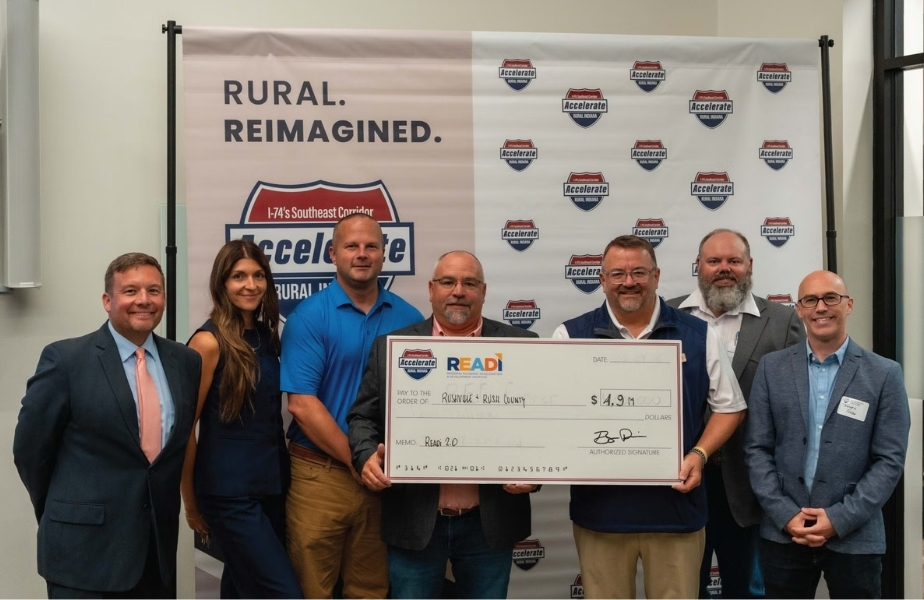
Rushville and Rush County representatives display a ceremonial $4.9 million READI 2.0 funding check at the Accelerate Rural Indiana event.

Rush County READI Investment: $4.9M Allocated

Rushville and Rush County projects receive $4.9 million in READI 2.0 allocations as Accelerate Rural Indiana celebrates regional progress.

The Rush County READI investment represents another important step in strengthening our community’s economic future. Through the Accelerate Rural Indiana regional partnership, Rushville and Rush County have been allocated $4.9 million in READI 2.0 funding for six local projects.

Economic development in Rush County doesn’t happen in isolation. Our community’s future is connected to the strength of neighboring counties, the availability of housing, the development of local businesses and the infrastructure needed to support future investment.

The community’s future is connected to the strength of neighboring counties, the availability of housing, the development of local businesses and the infrastructure needed to support future investment.

That regional approach reached an important milestone on October 1, 2026, when Accelerate Rural Indiana (ARI) gathered community and economic-development leaders at the Love Community Center in Rushville for its State of the Region celebration.

The organization announced that all $20 million of its original READI 1.0 award has now been disbursed to projects, ahead of Indiana’s year-end 2026 deadline.

Meanwhile, the region is advancing another $30 million in READI 2.0 funding, bringing its combined state READI awards to $50 million. WRBI Radio

What the Rush County READI Investment Means for Our Community

Rushville and Rush County are part of the Accelerate Rural Indiana partnership, which also includes Greensburg and Decatur County, Shelbyville and Shelby County, and Batesville.

The partnership works across community boundaries to pursue investments that support economic opportunity, workforce attraction and quality of life.

During the October 1 event, ARI presented ceremonial READI 2.0 funding checks representing 22 projects across its participating communities.

Rushville and Rush County’s allocation includes $4.9 million for six projects. WRBI Radio

These investments are part of a broader strategy to strengthen the region’s ability to attract businesses, support residents and prepare for future growth.

Investing in More Than Buildings

READI stands for Regional Economic Acceleration and Development Initiative.

The program supports locally developed strategies intended to strengthen Indiana communities through economic development, housing, infrastructure and quality-of-place improvements.

For Rush County, these investments matter because economic development requires more than having a site available for a new business.

Employers also need workers.

Workers need housing and community amenities.

Entrepreneurs need opportunities to establish and grow businesses.

And communities need infrastructure that can accommodate future investment.

When those pieces come together, they create a stronger foundation for long-term economic growth.

Rushville’s Love Community Center Demonstrates the Regional Approach

The location of this year’s State of the Region event was especially meaningful.

Rushville’s Love Community Center received $4 million in READI 1.0 funding and brings several community services together in one location.

The facility includes the Rushville Public Library, an early learning facility, a senior center, recreation facilities, a food pantry and social-service offices. WRBI Radio

It’s an example of how economic-development investments can support residents while helping create the type of community where people want to live and work.

The center also demonstrates why quality-of-place investments belong in conversations about workforce and business growth.

What’s Next for Regional Investment?

With READI 1.0 funding fully disbursed, Accelerate Rural Indiana is moving forward with READI 2.0.

According to the organization’s October announcement, all READI 2.0 projects have received formal approval from the Indiana Economic Development Corporation.

The region is also approaching 65% disbursement of its READI 2.0 funding, ahead of the program’s 2028 deadline. WRBI Radio

The regional project portfolio includes housing development, business and innovation facilities, infrastructure improvements and community assets.

Among the projects identified in Rushville are the Rushville Launch Center and additional housing initiatives.

These projects represent different pieces of the same economic-development strategy: preparing communities for business investment while creating opportunities for residents. Accelerate Rural Indiana

Understanding the Projected Economic Impact

Accelerate Rural Indiana has identified substantial potential economic benefits from its READI investments.

For READI 1.0, the organization forecasts more than $485 million in combined investment, including over $408 million in private investment and more than $34 million in local matching funds.

The region also projects more than 270 jobs, 600 housing units and 260 childcare seats associated with its READI 1.0 portfolio.

These figures are regional projections, not completed outcomes or Rush County-only totals.

ARI expects actual outcome data to be collected and reported in March 2027. GIANT fm

That distinction matters because the true measure of economic development is not simply the amount of funding awarded.

It is the lasting impact those investments produce.

How the Rush County READI Investment Supports Regional Growth

For rural communities, regional collaboration can create opportunities that would be difficult to pursue independently.

A stronger regional economy benefits employers, workers and families throughout the area.

Rush County’s participation in Accelerate Rural Indiana is part of that broader effort to strengthen economic opportunity, encourage investment and improve quality of place.

As READI 2.0 projects advance, the focus will increasingly shift from funding commitments to implementation and measurable results.

Rush County ECDC remains committed to supporting economic and community development efforts that position Rush County for long-term success.

To learn more about the regional initiative and its project portfolio, visit Accelerate Rural Indiana.

Learn more about Rush County ECDC’s ongoing economic and community development efforts by exploring our economic development resources.


Entrepreneur learning how to test a business idea before investing

Before You Spend the Money: 6 Ways to Test a Business Idea

Before you spend serious money on a new venture, it makes sense to test a business idea first. Having a business idea is exciting. Spending thousands of dollars before you know whether customers actually want what you’re selling is much less exciting.

One of the smartest things an aspiring entrepreneur can do is test a business idea before making major investments in equipment, inventory, a building, branding or other startup costs.

That doesn’t mean you have to prove that your idea will succeed before starting.

You can’t.

It means gathering enough information to make your next decision with something more useful than a guess.

1. Be Able to Explain What You’re Selling

Start with a deceptively simple question:

What problem does my business solve—or what does it provide that someone is willing to pay for?

Try explaining your business in one or two sentences without industry terminology.

Instead of:

“I want to start a bakery.”

Go further:

“I want to sell custom cakes and desserts for birthdays, weddings and special events to customers in and around Rush County.”

Now you have something you can begin testing.

Who buys it? How often? What alternatives already exist? What matters most to those customers—price, convenience, customization, quality or something else?

Clarity comes before a business plan.

2. How to Test a Business Idea With Potential Customers

Friends and family can be encouraging. However, they aren’t always good market research.

“That’s a great idea!” is very different from:

“Yes, I would pay $45 for that.”

Talk with people who could realistically become customers.

Ask what they currently buy, where they buy it, what they pay, what frustrates them and what would make them consider something different.

The goal isn’t to convince them your idea is good.

The goal is to listen.

Sometimes the most valuable information an entrepreneur receives is something they weren’t hoping to hear.

3. Know What It Really Costs

Pricing a product or service requires more than looking at what competitors charge.

Consider the actual cost of delivering what you’re selling.

Depending on the business, that can include materials, packaging, payment-processing fees, shipping, insurance, fuel, equipment, software, professional services, rent and—something new entrepreneurs frequently underestimate—your time.

If something costs $30 to produce and customers will only pay $25 for it, selling more of it doesn’t fix the underlying problem.

You don’t need perfect numbers on day one.

You do need realistic ones.

4. Look at the Competition

Importantly, competition isn’t necessarily evidence that your idea won’t work.

In fact, existing competitors can demonstrate that people already spend money on what you’re considering selling.

Study them.

What do they offer?

What do customers seem to value?

How are they priced?

Where do they sell?

What appears to be missing?

Then ask a harder question:

Why would someone choose my business?

“Because mine will be better” isn’t enough.

You should be able to identify something meaningful to the customer—service, convenience, expertise, location, selection, experience, customization, price or another genuine difference.

5. Test a Business Idea on a Small Scale

There are many inexpensive ways to test a business idea before making a major investment.

Someone considering a product-based business may be able to test a small product line before buying large amounts of inventory.

A service business might begin with a limited group of customers.

A food entrepreneur may have opportunities to test products through appropriate markets or events, subject to applicable health and licensing requirements.

A future storefront business may be able to validate customer demand before signing a lease.

The objective is not to stay small forever.

It’s to learn while the cost of changing direction is still relatively low.

6. Decide What the Next Decision Actually Is

Finally, you do not need to answer every question about a future business today.

You need enough information to answer the next one.

Should I keep researching?

Should I test my product?

Do I need to change my pricing?

Should I speak with a banker?

Is it time to formally organize the business?

Do I need professional advice about taxes, insurance, licensing or regulations?

Breaking entrepreneurship into decisions makes the process much more manageable.

Rush County Entrepreneurs Don’t Have to Figure It Out Alone

This is exactly the kind of early-stage thinking behind the Regional Entrepreneurial Pipeline, or REaP.

The free eight-session program serving Rush, Fayette and Henry counties begins October 1, 2026 and covers business readiness, customers, pricing, sales, marketing, banking and financing, understanding business numbers, business formation and next-step resources. Virtual participation is also available when participants cannot attend a session in person. Rush ECDC

REaP isn’t designed around the assumption that everyone who has a business idea should immediately start a company.

Should I keep researching?
Is it time to test my product?
Would changing my pricing make sense?
Should I speak with a banker?
Is it time to formally organize the business?
Do I need professional advice about taxes, insurance, licensing or regulations?

All three can be progress.

If you have a business idea, side hustle, home-based business or early-stage company, Rush County ECDC can help connect you with resources and people who can help you make more informed decisions.

Learn about the Regional Entrepreneurial Pipeline (REaP)

Entrepreneurs can also explore business planning and startup resources through the Indiana Small Business Development Center (Indiana SBDC)

Employee development in Rush County through on-the-job training

Your Next Great Hire May Already Work for You: Building Talent From Within

Your Next Great Hire May Already Work for You: Building Talent From Within

Employee development in Rush County can be just as important as recruiting new workers. When employers need additional skills, supervisors or people prepared to take on more responsibility, the first place to look may be inside their own organization.

Hiring will always be an important part of workforce development. But employers also have another valuable workforce strategy: developing the people they already have.

That can mean helping an entry-level employee gain new technical skills, preparing an experienced worker for a leadership role, creating clearer career pathways or giving employees opportunities to advance as the needs of the business change.

For employers, that isn’t simply training.

It’s workforce development.

Why Employee Development in Rush County Matters

Every employee who gains a new skill adds capacity to an organization.

Developing current employees can help businesses build the skills they need while creating opportunities for workers to advance without leaving the company—or the community—to find their next opportunity.

It can also help employers think differently about workforce shortages.

Instead of asking only, “Where can we find someone who already has every skill we need?”, another useful question is:

“Who do we already have that could grow into this role?”

Sometimes the strongest candidate for tomorrow’s opening is already on today’s payroll.

Career Pathways Don’t Have to Be Complicated

Creating opportunities for advancement doesn’t necessarily require a large formal program.

Employers can begin by looking at positions that are difficult to fill or skills that are becoming increasingly important.

Consider questions such as:

  • Which positions are hardest for us to recruit?
  • Which employees have demonstrated the ability to take on more responsibility?
  • What skills would someone need to move from an entry-level position into a more advanced role?
  • Are experienced employees approaching retirement who hold knowledge that needs to be transferred?
  • Could training help an existing employee fill a future need?

Those conversations can turn workforce planning from a reaction to a vacancy into preparation for one.

Indiana Is Encouraging Employers to Grow Their Own Talent

Indiana is also placing increased emphasis on developing workers who are already employed.

The Indiana Department of Workforce Development’s Power Up Indiana initiative encourages employers to build employee skills and career pathways and includes an employer incentive component. DWD describes the initiative as a way for businesses to develop existing talent while supporting wage growth and advancement.

Employers interested in the program should review current requirements directly with DWD before making training or financial decisions, because eligibility and reimbursement requirements apply.

Learn about Power Up Indiana through Indiana DWD

Power Up Indiana isn’t the only workforce resource available to employers. Depending on the business, employee and type of training involved, other state or workforce programs may also be worth exploring.

Start With the Workforce Need

The most useful starting point isn’t necessarily asking, “What grant can I get?”

Start with the business problem.

Maybe you need more skilled operators.

Maybe you’re having difficulty developing frontline supervisors.

Maybe technology is changing the skills required for a position.

Maybe you have a strong employee who is ready for more responsibility but needs additional training.

Once the need is clear, ECDC and workforce partners can help determine whether there are resources or connections worth exploring.

Employee Development in Rush County Starts From Within

Recruitment gets a lot of attention because vacancies are easy to see.

Employee development can be less visible, but it is an important part of building a resilient workforce.

A worker who sees an opportunity to learn, advance and build a career has a reason to imagine a future with that employer.

A business that continually develops its people builds skills it can draw on as needs change.

And when Rush County businesses and workers grow together, the entire community benefits.

Is your business thinking about training, advancement, succession planning or another workforce challenge?

Rush County ECDC can help you identify workforce resources and connect with the appropriate partners. Start by telling us what your business is trying to accomplish.

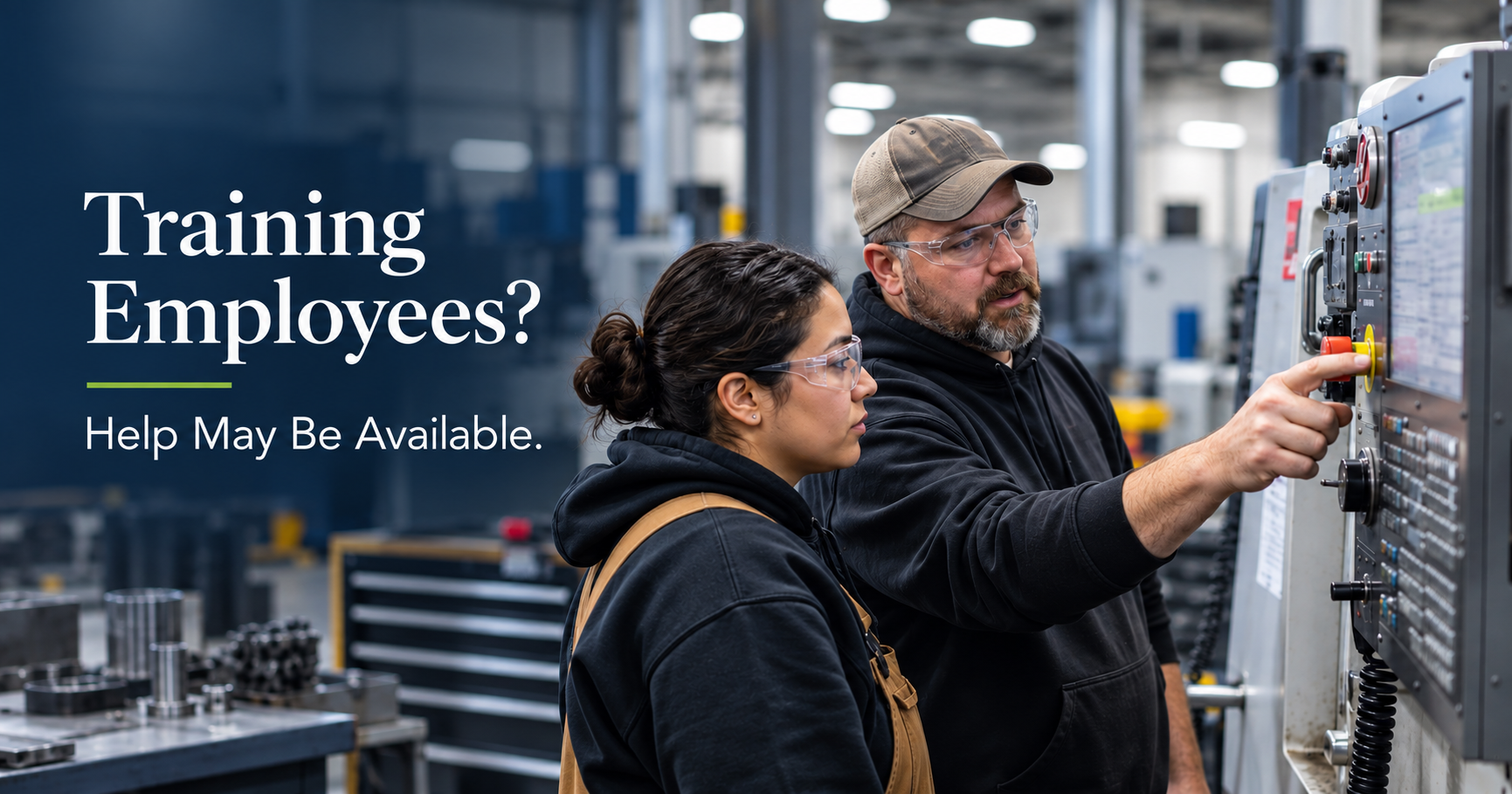
Employee receiving manufacturing training for the Indiana Employer Training Grant

Could Your Business Get Help Paying to Train Employees? Indiana Employers Have an Option

The Indiana Employer Training Grant may help qualifying businesses offset the cost of training new or current employees.

Training employees costs money. Whether a business is teaching a new hire the skills needed for a position or helping an existing employee advance into a more skilled role, that investment can add up quickly.

Indiana employers may have a resource available to help offset some of those costs.

The Employer Training Grant, administered by the Indiana Department of Workforce Development, reimburses qualifying Indiana employers for eligible occupational-skills training for new or current employees working in high-demand positions.

For Rush County employers planning to strengthen their workforce, it’s a program worth knowing about.

How the Indiana Employer Training Grant Can Help

According to current Indiana DWD guidance, participating employers can receive up to $50,000 in reimbursements.

Eligible employers may receive reimbursement of up to $5,000 per newly trained employee, subject to program requirements. Workers must be trained, hired and retained for at least six months, and the training must meet the state’s eligibility standards.

This isn’t simply reimbursement for routine orientation or informal job shadowing.

The training must build occupational skills connected to an eligible, in-demand occupation.

What Types of Businesses May Qualify?

The Employer Training Grant currently supports training associated with six priority sectors:

  • Advanced Manufacturing
  • Agriculture
  • Building & Construction
  • Health & Life Sciences
  • IT & Business Services
  • Transportation & Logistics

Indiana-based employers of any size are encouraged to apply, although the proposed training and occupations must satisfy the program’s requirements.

That makes the program particularly relevant in a community like Rush County, where several of these sectors are important parts of the local and regional economy.

What Kind of Training Counts?

This is where employers should pay close attention.

Eligible training must meet Indiana Department of Workforce Development requirements and be connected to qualifying occupational skills and eligible positions. Routine onboarding, general human-resources training and informal job shadowing may not qualify.

Additional eligibility requirements apply, including requirements related to the employees being trained, wages, training duration and retention. Because program requirements can change, employers should confirm current requirements with the Indiana Department of Workforce Development before beginning training or making financial decisions based on anticipated reimbursement.

The best first step is to discuss the proposed training before it begins. That allows an employer to determine whether the business, employees and planned training meet current program requirements.

Why Employer Training Matters in Rush County

Workforce development isn’t only about finding someone to fill an open position.

Sometimes the person an employer needs is already on the payroll—or a strong candidate can become the right employee with additional training.

Developing workers internally can help employers build skills that match their specific operations while creating advancement opportunities for employees.

Indiana’s Employer Training Grant is designed around that concept: helping businesses grow their own talent.

For employers struggling to find workers with every skill they need on day one, that approach can open another option.

Instead of asking only:

“Where do we find someone who already has these skills?”

it may also be worth asking:

“Can we develop those skills in someone we already have—or someone we’re willing to hire?”

Indiana Employer Training Grant: What Employers Should Know

One important point: employers shouldn’t complete training and assume they can request reimbursement afterward.

DWD’s process requires employers to submit information about their proposed training and work with the program before reimbursement. The state describes the process in three basic steps: apply, establish the training program, and then seek reimbursement after program requirements are met.

If your Rush County business is considering hiring, upskilling employees or developing workers for harder-to-fill positions, investigate the program before the training begins.

Indiana DWD Employer Training Grant information

Rush County employers can also contact the Rush to Work Job Center/WorkOne in Rushville to discuss workforce needs and available employer resources.

Workforce development works best when businesses don’t have to navigate every resource alone.

Rush County workforce and economic development

What the Latest Workforce Data Tells Us About Rush County

The latest Rush County workforce data provides a new snapshot of local employment, wages and the businesses that employ our workforce.

According to data released September 4 by the U.S. Bureau of Labor Statistics, Rush County had 428 covered establishments and 4,972 covered jobs in March 2026. The county’s average weekly wage during the first quarter of 2026 was $1,016.

Those numbers are more than statistics. They help provide context for the economic and workforce development work happening throughout Rush County.

Understanding Rush County Workforce Data

The Bureau of Labor Statistics figures come from the Quarterly Census of Employment and Wages, commonly called QCEW.

The data includes workers covered by state unemployment insurance programs and federal workers covered by the Unemployment Compensation for Federal Employees program. Because of that definition, these numbers should not be interpreted as every person who works or every business operating in Rush County.

Instead, they provide a consistent way to examine employment and wages across communities.

What Rush County Workforce Data Tells Us

Rush County workforce data becomes more useful when we put the numbers into context. Rush County’s first-quarter average weekly wage of $1,016 compares with an Indiana average of $1,356. Statewide, Indiana had approximately 3.16 million covered jobs in March 2026, while the state’s average weekly wage increased 2.7% from the first quarter of 2025.

Rush County is one of Indiana’s smaller employment markets, which makes the strength and competitiveness of individual employers particularly important to the local economy.

For economic development, the goal isn’t simply to increase one number.

A healthy local economy requires businesses that can compete, workers who can build successful careers, a pipeline of future talent, and a community that can attract and retain both employers and residents.

Why Workforce Development Matters

Workforce data also reinforces why economic development and workforce development cannot operate separately.

When an existing employer wants to expand, workforce availability matters.

When a company considers Rush County for a new investment, access to talent matters.

When students make decisions about education and careers, knowing what opportunities exist locally matters.

And when residents are looking for better employment opportunities, connections to employers, training and career resources matter.

That is why Rush County ECDC works across several parts of the talent pipeline—from helping employers address current workforce needs to connecting residents with employment resources and helping students gain exposure to local careers.

Building for the Future

Rush County workforce data from a single quarter doesn’t tell the entire story of our local economy, and preliminary federal data can be revised.

What it does give us is another useful benchmark.

As Rush County works to attract investment, support existing businesses and strengthen its talent pipeline, tracking employment and wage data helps us better understand where we are—and where opportunities exist to keep moving forward.

Rush County ECDC will continue working with employers, educators, workforce partners and community leaders to help build a stronger local economy and create opportunities for the people who call Rush County home.

Source: U.S. Bureau of Labor Statistics, Quarterly Census of Employment and Wages, First Quarter 2026. Data is preliminary.

View the September 4 BLS County Employment and Wages report

Local small business in Rush County, Indiana

Have a Business Idea? 5 Questions to Answer Before You Launch

Thinking about starting a business in Rush County? You may have a great idea, a side hustle that’s gaining traction, or a skill you’ve wondered whether you could turn into a business. But knowing where to begin can sometimes be the hardest part.

Sometimes it starts with someone saying:

“I wonder if people would pay me to do this.”

It may be a product you’ve started selling to friends. A service people regularly ask you to provide. A skill you’ve considered turning into a side business. Or an idea you’ve been carrying around for years but haven’t known what to do with.

If you’re thinking about starting a business in Rush County, you don’t need to have everything figured out before taking the first step.

But there are some important questions worth answering before investing significant time or money.

1. What Problem Does Your Business Solve?

A good business idea isn’t simply something you enjoy doing.

Someone else has to value it enough to pay for it.

Start by identifying the customer you believe would buy your product or service and why.

What problem are you solving?

What need are you filling?

What would make someone choose your business instead of doing nothing—or buying from someone else?

Indiana’s entrepreneurship resources encourage prospective business owners to research whether their idea addresses an actual market need before investing heavily in launching it. The Indiana Small Business Development Center can also provide entrepreneurs with access to market research and confidential business advising at no cost.

You don’t need a hundred-page market study to begin.

You do need to know who your customer is.

2. Have You Talked to Potential Customers?

Friends and family saying, “That’s a great idea!” can be encouraging.

It isn’t necessarily market research.

Try talking to people who would actually be potential customers.

Ask what they currently use or buy. Find out what they like and dislike about existing options. Learn what matters most when they make a purchasing decision.

If you’re already operating informally or as a side hustle, pay attention to what your actual customers are telling you.

Which products or services sell?

What questions do customers repeatedly ask?

What do they request that you don’t currently offer?

Real customer behavior can teach you considerably more than guessing what people might want.

3. Do the Numbers Work?

Revenue and profit are not the same thing.

If you sell something for $50, that doesn’t mean you’ve made $50.

Before setting a price, identify the costs associated with delivering your product or service. Depending on the business, those might include materials, supplies, shipping, payment-processing fees, insurance, equipment, transportation, advertising, professional services and your own time.

Then ask a critical question:

Can I charge a price customers will pay and still operate profitably?

Understanding your numbers before you grow can prevent a common small-business problem: creating plenty of work without creating enough income.

This is also why financial planning and recordkeeping matter even when a business is very small.

4. What Needs to Happen Before You Make It Official?

One of the most confusing parts of entrepreneurship can be figuring out what paperwork actually applies to your business.

Indiana’s INBiz portal is the state’s one-stop resource for registering and managing businesses. It provides information about business structures, name availability, registered agents and state filing requirements.

Depending on the type of business, additional tax, licensing, employer or local requirements may also apply. The Indiana Department of Revenue notes that new businesses may need to register for appropriate state tax accounts through INBiz.

That doesn’t mean your first step should automatically be filing an LLC.

Your first step should be understanding which steps apply to your particular business.

Getting good information before filing paperwork can save time, money and frustration later.

5. What’s Your Next Step—not Your Next 50 Steps?

Starting a business can feel overwhelming because entrepreneurs often try to solve every future problem at once.

What should the business be called?

Do I need an LLC?

What about taxes?

Do I need a website?

How do I market it?

Where will I get financing?

Should I open a business bank account?

What records should I keep?

Those are legitimate questions.

They just don’t all have to be answered today.

Instead, identify the next useful step.

Maybe that’s talking with five potential customers.

Maybe it’s calculating the true cost of your product.

Maybe it’s meeting with a business advisor.

Maybe it’s learning what a lender would want to see.

Or maybe you’re ready to formalize a business you’ve already started.

Progress becomes much more manageable when you stop trying to build the entire business at once.

Rush County Entrepreneurs Don’t Have to Figure It Out Alone

If you’re considering starting a business in Rush County, you don’t have to figure everything out on your own.

Rush County ECDC and our regional partners are currently offering another resource specifically for people at this stage.

The Regional Entrepreneurial Pipeline (REaP) is a free workshop series serving new and early-stage entrepreneurs in Rush, Fayette and Henry counties.

REaP is designed for people with a business idea, side hustle, home-based business or young business they want to strengthen. Topics include business readiness, banking and lender expectations, customers, pricing, sales, marketing, business formation, recordkeeping and other practical steps involved in building a business.

Participants can choose the sessions that fit their needs and participate either in person or virtually.

You don’t need to arrive with everything figured out.

That’s the point.

Have an idea you’ve been thinking about?

Visit the Regional Entrepreneurial Pipeline (REaP) page to learn more and register.

Sometimes the difference between an idea that stays an idea and one that becomes a business is simply knowing what to do next.

Rush County development-ready sites at Commerce Park at Rushville

Why Development-Ready Sites Matter to Rush County’s Economic Future

Economic development often becomes visible when a company announces an expansion, construction begins or new jobs are created.

But much of the work that makes those opportunities possible happens years before an announcement.

One important part of that preparation is having Rush County development-ready sites that businesses can seriously evaluate when they are considering where to locate or expand.

Companies Need Answers Before They Invest

Businesses considering a new location evaluate much more than the price of a piece of land.

They need to understand whether a site can accommodate their operation, how utilities can serve it, whether the property is appropriately zoned, how transportation connects to the site and what may be required before construction can begin.

And increasingly, companies need those answers quickly.

Indiana’s economic-development strategy emphasizes site readiness because reducing uncertainty can help companies move more efficiently through the location process. The Indiana Economic Development Corporation describes development-ready sites as an important tool for helping businesses move faster toward operational launch.

For communities competing for investment, preparation matters.

Rush County Development-Ready Sites Support Investment

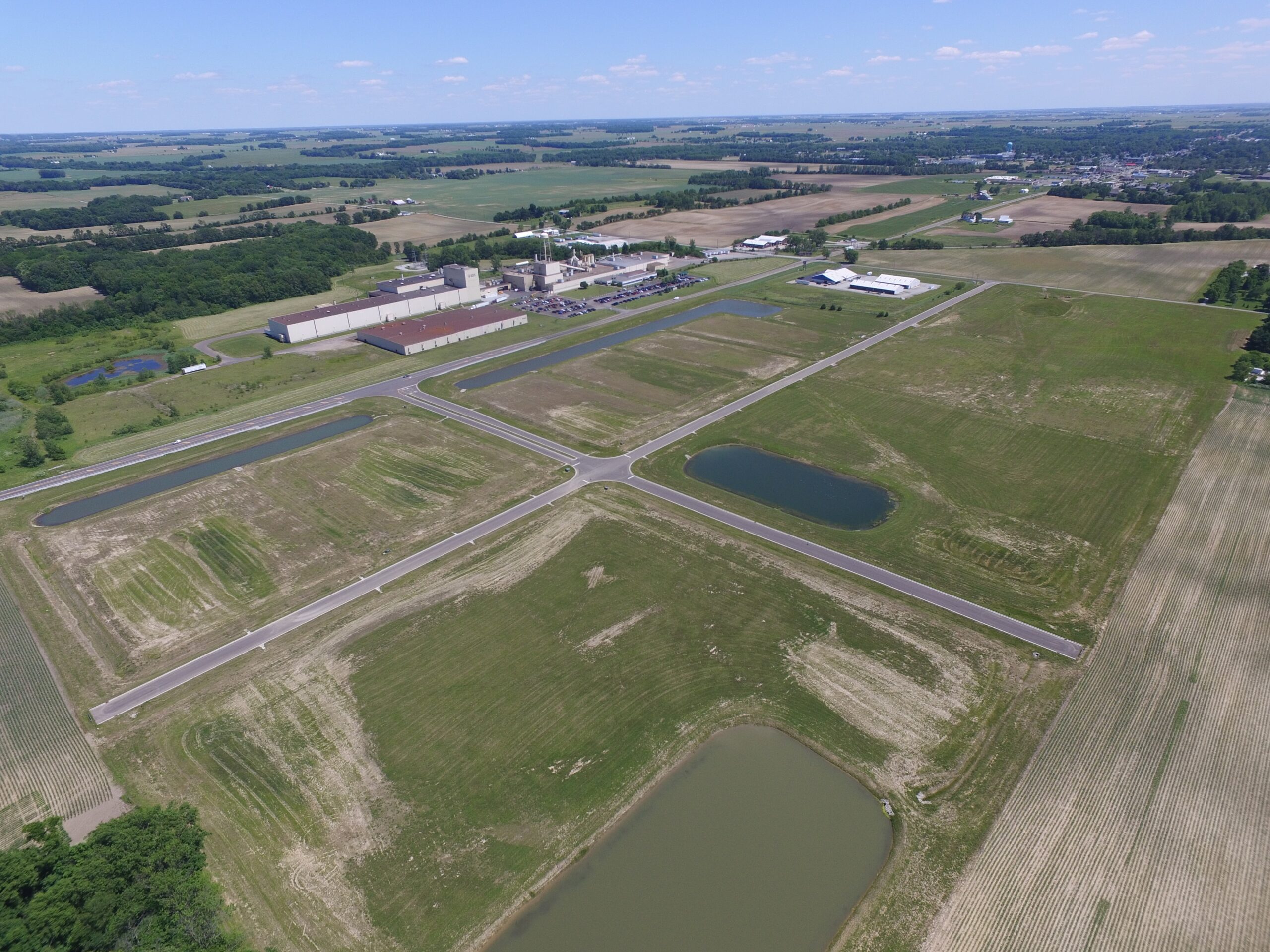
One of Rush County’s major economic-development assets is Commerce Park @ Rushville, located at State Road 3 and County Road 200 North.

The Commerce Park received Indiana Site Certified Prime designation in 2019, the highest level under the state’s Site Certified program at the time. The designation followed years of local, state and federal investment in preparing the property for industrial development.

Today, ECDC’s available-sites information identifies infrastructure serving the Commerce Park that includes water, sewer, natural gas and fiber connectivity.

Those aren’t particularly flashy economic-development accomplishments.

They are, however, exactly the kinds of fundamentals that matter when a company begins evaluating whether a community can accommodate a project.

Site Readiness Reduces Uncertainty

Imagine two communities being considered for the same investment.

One has property available but still needs to determine whether appropriate infrastructure can reach it.

The other can provide information about an established development site, existing infrastructure and previous site-readiness work.

The second community can begin answering questions much earlier in the conversation.

That doesn’t guarantee that it will win the project. Businesses weigh many factors when making location decisions, including workforce, transportation, utilities, costs, incentives and proximity to customers and suppliers.

But having prepared sites means Rush County can enter those conversations with an important piece already in place.

Economic Development Requires Long-Term Thinking

The Commerce Park is also a good example of something that can be easy to overlook about economic development:

Preparation and results don’t always happen in the same year.

Infrastructure investments may be made years before a company needs them.

Workforce initiatives begin before an employer has an opening.

Housing and quality-of-place investments help create conditions that make a community more attractive to people and businesses over time.

And development sites have to be prepared before a site selector calls.

That requires communities to think beyond the next announcement and invest in the capacity needed for future opportunities.

Rush County Development-Ready Sites Are Part of a Bigger Strategy

Rush County development-ready sites are an important part of preparing our community for future business investment, even though much of that preparation happens long before a company announcement or groundbreaking. Commerce Park @ Rushville is an important asset, but it isn’t the only location ECDC can help businesses evaluate.

Companies have different requirements. Some need large acreage. Others need an existing building, commercial property, a smaller industrial site or room for a future expansion.

That’s why Rush County ECDC now offers businesses a customized property search based on project requirements such as acreage, building size, utility needs, transportation access and expansion plans.

The goal isn’t simply to have property available.

The goal is to help businesses determine whether Rush County is the right place for their investment.

That work starts long before a groundbreaking.

It starts with being ready when opportunity calls.

Considering a location or expansion in Rush County?
Visit ECDC’s Available Sites page or contact Rush County Economic & Community Development Corporation to begin a confidential property search.

Rush County talent pipeline students exploring local careers

The Talent Pipeline Starts Before Graduation: How Career Exposure Strengthens Rush County

Building the Rush County talent pipeline requires us to think beyond today’s job openings and look at the young people who will become tomorrow’s workforce. When employers talk about workforce challenges, the conversation often focuses on the people available to hire today.

But building the Rush County talent pipeline means looking further ahead. Our future workforce is already sitting in classrooms.

That is why career exploration, employer engagement and work-based learning are important parts of economic development. Helping young people understand the opportunities available close to home gives students more information when making decisions about education and careers—and gives local employers an opportunity to begin building their future talent pipeline.

Career Awareness Matters Earlier Than We Think

Students make important choices long before they submit their first full-time job application.

They choose classes. They consider college, technical education, apprenticeships and military service. They decide whether they believe they need to leave their hometown to find opportunity.

Those decisions are influenced by what students know.

A young person can live near a business for years without knowing what happens inside the building, what occupations exist there, what education those jobs require or what a career path with that employer might look like.

Creating direct connections between students and employers helps close that information gap.

Building the Rush County Talent Pipeline

Career-connected learning isn’t a new idea in Rush County.

Rush County Schools received national attention earlier this year when Business View Magazine highlighted the district’s approach to education and community partnerships. The February 2026 feature described several ways students are connecting education with career preparation, including healthcare credential opportunities and on-the-job experience through the district’s Interdisciplinary Cooperative Education program.

Those experiences matter because career exploration becomes much more meaningful when students can connect what they learn in school with an actual occupation.

The same principle is behind initiatives such as Rush County Manufacturing Day.

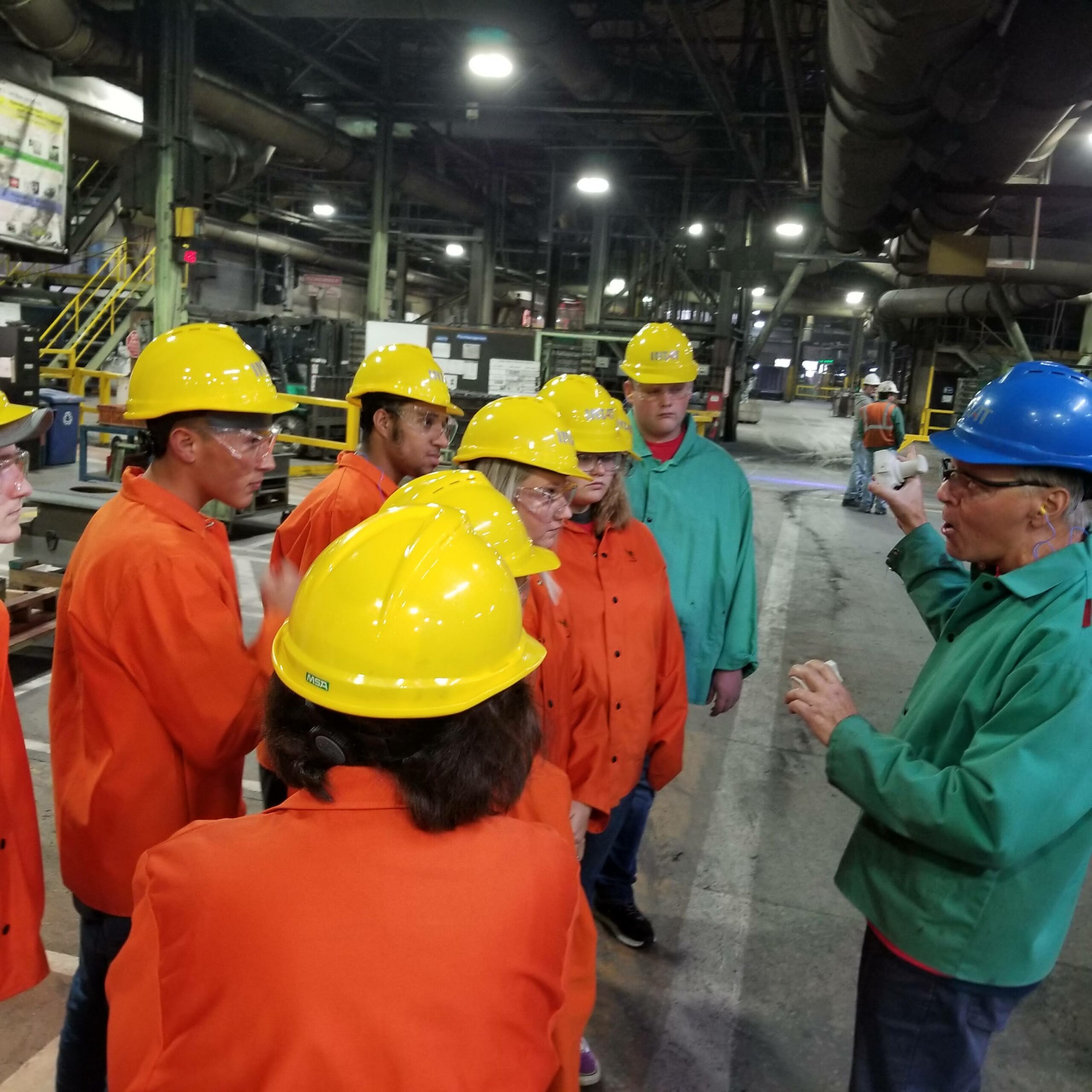
Manufacturing Day gives students an opportunity to step inside local workplaces, meet employees and learn about career pathways they may otherwise never see. Rush County ECDC is again working with local education and employer partners on Manufacturing Day activities in 2026.

Employers Have a Role in Building Their Future Workforce

Employers don’t have to wait until students graduate to participate in workforce development.

There are many ways businesses can help young people better understand the world of work.

Hosting a tour can introduce students to occupations they didn’t know existed.

Speaking to a classroom can help explain which skills employers value.

Providing job-shadowing or work-based learning opportunities can give a student firsthand experience.

Participating in career events can help students connect a company name they recognize with actual careers and the people who perform them.

Even a conversation with an employee can change how a student thinks about a career.

These interactions aren’t necessarily about recruiting a teenager for an immediate opening.

They are about building awareness.

Career Exposure Also Helps Students Make Better Decisions

A strong talent pipeline benefits employers, but students benefit too.

The more students understand about occupations, workplace expectations, education requirements and career pathways, the better equipped they are to make decisions about what comes after high school.

For one student, that may mean a four-year degree.

For another, it may mean technical training, an industry credential, an apprenticeship or entering the workforce.

There isn’t one correct pathway.

The goal is to make sure students know the pathways exist.

Showing Young People They Can Build a Future Here

Talent attraction will always be important to economic development, but communities also have an opportunity to develop and retain the talent already growing up within them.

That starts with visibility.

Young people need opportunities to see local workplaces, meet people building successful careers and understand how education connects to employment.

Employers need opportunities to communicate the skills and qualities they will need from tomorrow’s workforce.

Schools need partners who can help make classroom learning relevant to life after graduation.

When those pieces come together, career exploration becomes more than an educational activity.

It becomes economic development.

Rush County ECDC will continue working with employers, educators and workforce partners to help create those connections and strengthen the pipeline between education and opportunity in Rush County.

Why a Busy Downtown Matters to Rush County’s Economy

A strong downtown Rushville economy is an important part of economic development in Rush County.

Economic development doesn’t happen only in industrial parks. It also happens when someone opens a small business, a family spends Saturday morning downtown, a visitor discovers a local restaurant or shop, and community events bring people together in places Rush County has invested in creating.

It also happens when someone opens a small business, a family spends Saturday morning downtown, a visitor discovers a local restaurant or shop, and community events bring people together in the places Rush County has invested in creating.

Rushville will have a good example of that in action on Saturday, September 19, when Willkie Days—also promoted as Rush Fest—returns to downtown Rushville.

The Rush County Chamber of Commerce-organized event is scheduled from 9 a.m. to 2 p.m. and will bring local shops, vendors, food, children’s activities and community members together downtown.

But events like this have value beyond a single Saturday.

The Downtown Rushville Economy Supports Local Business

Small businesses are an important part of the downtown Rushville economy and the broader Rush County economy.

Community events can introduce residents and visitors to businesses they haven’t tried before, create opportunities for entrepreneurs and vendors to reach customers, and generate additional foot traffic for established downtown businesses.

Willkie Days is particularly well positioned for that this year because it overlaps with the Heart of Rushville Farmer’s & Artisans Market, which is scheduled from 9 a.m. to 12:30 p.m. September 19. The market provides a regular downtown outlet for local produce, baked goods and handcrafted products.

For someone testing a product, building a customer base or operating a very small business, markets and community events can provide valuable exposure.

For existing storefronts, they bring potential customers directly to the neighborhood.

Quality of Place Is Part of Economic Development

There is another reason vibrant community spaces matter to Rush County ECDC.

Businesses don’t make location and expansion decisions based on buildings and infrastructure alone. Workers and their families also make decisions about where they want to live.

That makes quality of place part of the economic-development equation.

A downtown that offers local businesses, public events, entertainment and opportunities for people to gather contributes to the experience of living in a community.

On September 19, Rushville will have several examples happening on the same day.

In addition to Willkie Days and the Farmer’s & Artisans Market, the Rush County Community Calendar currently lists the Summer Concert Series season event at Riverside Park Amphitheater that evening, with On the Border – The Ultimate Eagles Tribute and The Morgan After Band.

The Princess Theatre also has performances scheduled that weekend.

Together, activities like these give residents reasons to spend time locally and give visitors reasons to experience Rushville.

Entrepreneurship Often Starts Small

Downtown events also connect directly to another ECDC priority: entrepreneurship.

Not every business begins with a building, employees and a large investment.

A business may begin at a kitchen table, in a garage, online or with someone selling a product at a local market.

Creating places where small and emerging businesses can meet customers helps build an environment where entrepreneurship is visible and accessible.

Rush County ECDC is working on that same goal through the Regional Entrepreneurial Pipeline, or REaP, which provides free workshops and resources for new and early-stage entrepreneurs in Rush, Fayette and Henry counties.

Community events and formal entrepreneurship programs serve different purposes, but they reinforce the same idea:

Local businesses need opportunities to start, connect with customers and grow.

Supporting the Downtown Rushville Economy

Willkie Days is a celebration, not an economic-development program.

And that is precisely the point.

Economic development ultimately isn’t just about completing projects. It is about building a community where businesses can succeed and people want to spend their time, build careers, raise families and invest.

Sometimes supporting that goal is as simple as showing up.

Visit downtown. Explore a business you haven’t visited before. Meet a local vendor. Have lunch. Attend an event.

Every local purchase won’t transform an economy by itself.

But strong local businesses, active community spaces and residents who support them are all pieces of a stronger Rush County.

Willkie Days / Rush Fest
Saturday, September 19, 2026
9 a.m.–2 p.m.
Downtown Rushville

For the most current event information, visit the Rush County Community Calendar.

Rush County students touring a local manufacturing facility during Manufacturing Day

Why Manufacturing Day Matters for Rush County’s Future Workforce

Manufacturing Day is coming this October, and Rush County Economic & Community Development Corporation is once again working with local education and employer partners to help students explore careers available close to home.

National Manufacturing Day will be observed on Friday, October 2, 2026. Organized by the Manufacturing Institute, the annual initiative encourages manufacturers and their partners across the country to introduce students, educators and communities to modern manufacturing through plant tours, hands-on experiences, career conversations and other activities.

For Rush County, Manufacturing Day is about more than celebrating an industry.

It is about building a stronger local talent pipeline.

Read More